
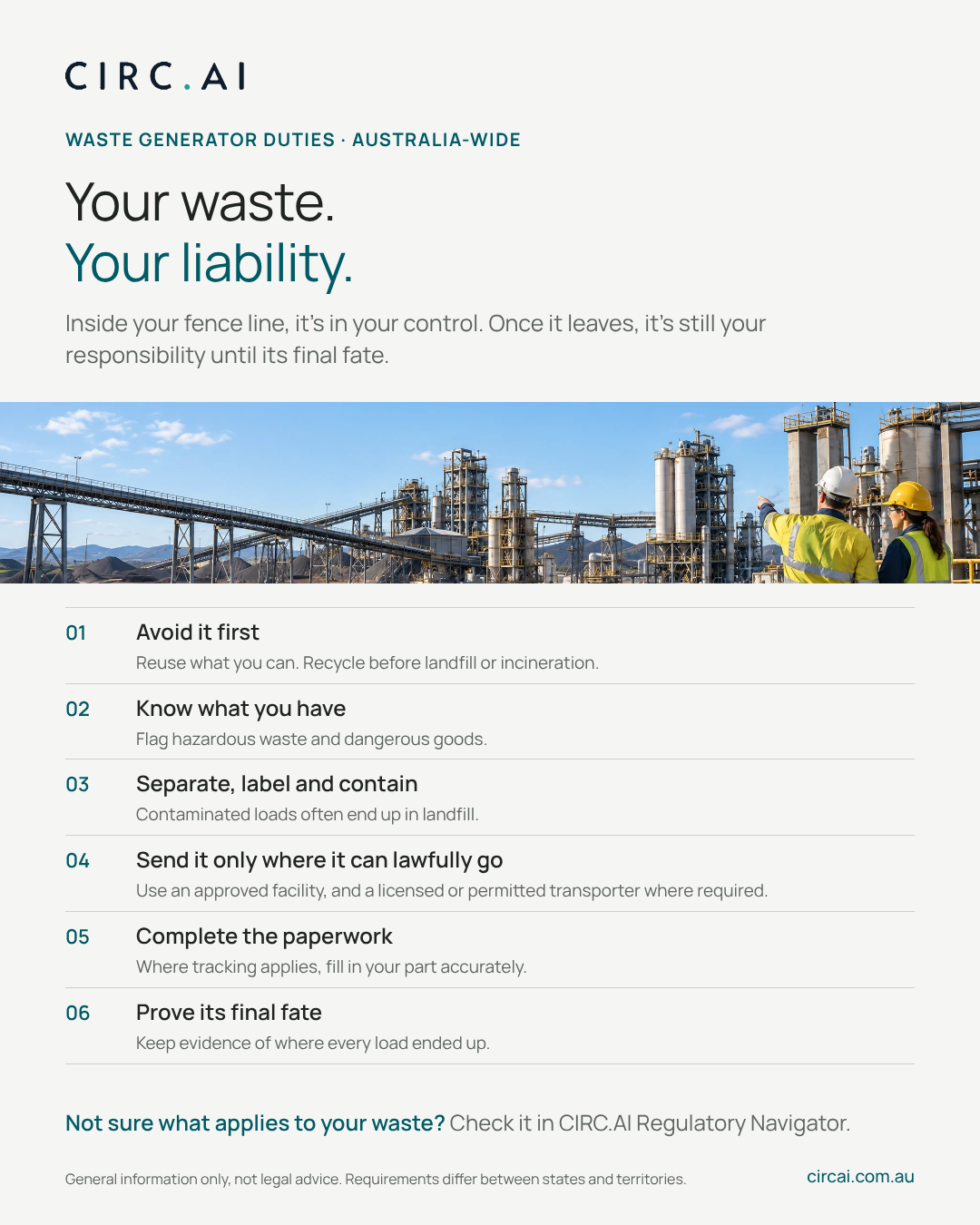
Your waste. Your liability.

By Kim Horwood, Director, CIRC.AI. Environmental scientist with 20+ years in waste regulation.
· 9 min read · Current as at November 2026
The short answer: Your waste stays linked to you until its final fate: recycled, treated, destroyed or lawfully disposed of. Most states and territories impose a general environmental duty, while NSW and WA rely on specific offences. Directors and managers can be personally liable, and the detail changes at every border.
Key takeaways
- Your waste stays linked to you until it is recycled, treated, destroyed or lawfully disposed of.
- Most states and territories impose a general environmental duty. NSW and WA rely on specific offences instead.
- Directors and managers can be personally liable, and penalties can reach millions of dollars.
- The principles are national. Classification, permits and tracking rules change at every border.
Everyone generates waste. Every person, every home and every business.
Waste tells a story, and it leaves a legacy. Yet it is usually the last thing anyone thinks about, in daily life, in operations and on projects. It adds cost. It lingers. Managed badly, it harms people, the environment and a company’s reputation.
Inside your fence line, your waste is in your control, and you must manage it lawfully.
Once it leaves, it is still your waste, your responsibility and your liability. It is just no longer in your control.
Your responsibility follows the waste
Your waste stays linked to you until it reaches its final fate. That means it has been recycled into something new, treated, destroyed or lawfully disposed of. Until then, it can be traced back to you, and so can the damage to your reputation.
In many cases you can also remain legally liable. Examples include NSW, where both the owner and the transporter commit an offence if waste goes to a place that cannot lawfully accept it. [8] In Victoria, anyone who manages industrial waste must take reasonable steps to check it will go somewhere lawful. [10]
Don’t rely on mixing or diluting waste to end the risk. If it ends up stockpiled, abandoned or stored somewhere it shouldn’t be, it becomes “stranded waste”. When stranded waste is traced back to a company, the clean-up bill and the headlines can follow.
What the law expects
Most states and territories impose a general environmental duty: take reasonable steps to prevent harm from pollution and waste. How it works differs. Researched examples include:
- Victoria. The duty sits in the Environment Protection Act 2017. Breaching it is an offence. [1]
- Queensland. The duty is in section 319 of the Environmental Protection Act 1994. [2] We could not confirm whether breaching it is an offence in itself.
- South Australia. Section 25 of the Environment Protection Act 1993 requires all reasonable and practicable measures to minimise harm. [3] Again, it is not clear from the sources we found whether a breach is an offence in itself.
- Tasmania. Section 23A of the Environmental Management and Pollution Control Act 1994 sets the duty. Breaching it is not an offence in itself, but taking reasonable steps can be a defence. [4]
- Northern Territory. The Environment Protection Act 2019 includes the duty, with no specific offence for failing it. [5]
- ACT. Section 22 of the Environment Protection Act 1997 sets the duty. Breaching it is not an offence in itself. [23]
- NSW and WA. Neither has a general environmental duty. [6, 7] They rely on specific offences, such as the NSW offence for sending waste somewhere unlawful (POEO Act s 143), and WA’s pollution and dumping offences (EP Act s 49 and s 49A). [8, 9]
States and territories also have offences for causing pollution or environmental harm. Researched examples include NSW’s offence of disposing of waste in a way that harms the environment, and WA’s pollution offences. [8, 9]
What every waste generator should do
- Avoid it first. The cheapest waste is the waste you never create. Reuse what you can across your own sites. Then cut volumes: can you concentrate it, treat it on site, sell it, repair it or reclaim it? When waste has to leave, recycle or repurpose it before considering landfill or incineration.
- Know what you have. Identify every waste stream, and which are hazardous waste or dangerous goods. Examples of wastes with special rules include asbestos, batteries, e-waste, tyres, waste oil and clinical waste.
- Separate it. Keep streams apart. Contaminated bins and skips are likely to end up in landfill, at a higher cost.
- Label it. Label every container clearly, and replace labels that fade or peel.
- Store and handle it safely. Keep incompatible wastes and chemicals apart. Dangerous goods and work health and safety laws apply on site, not only in transport. Make sure your people know the risks.
- Contain it. Waste must not spill, leak or blow away. Littering is an offence.
- Send it only where it can lawfully go. Use a facility approved to accept that waste. Where a licence or permit is needed to carry it, use a transporter that holds one.
- Complete the paperwork. Where tracking applies, fill in your part of the record accurately. False records are taken seriously, as the NSW cases below show. [12, 13]
- Report incidents. Pollution incidents above set thresholds must be reported. For example, the NT requires notice of incidents that cause or threaten material or serious environmental harm. [5]
- Close the loop. Keep evidence of where every load ended up.
This is on you
Directors and managers can be personally liable for environmental offences committed by their business. Penalties can be heavy. In NSW, for example, the most serious waste offences carry up to $10 million for a corporation acting wilfully. [11]
Regulators also check the paperwork. Researched examples from NSW include:
- Two related Central Coast companies ordered to pay $57,000. One had supplied falsified dockets for 1,033 tonnes of asbestos waste. [12]
- A construction contractor fined $40,000 for 68 falsified dockets claiming 990 tonnes went to an approved facility. [13]
The detail changes at every border
The principles apply across Australia. The detail does not. Researched examples include:
- Classification. Batteries are a good test. Victoria pre-classifies most business battery waste as priority waste. [14] NSW names business lead-acid and nickel-cadmium batteries as hazardous. [15] Queensland’s trackable waste list has no battery entry. [24] South Australia bans lead-acid batteries from landfill. [25] WA’s e-waste landfill ban covers batteries, other than embedded ones. [26] ACT guidance says batteries must never go in household bins. [27] For Tasmania and the NT, we found no battery-specific rule.
- Transport permits. NSW requires an environment protection licence for loads over 200 kg of certain wastes. [28] Victoria uses A10a permits and A10b registrations. [16] Queensland may require an environmental authority (ERA 57). [29] WA licenses controlled waste carriers, plus drivers and vehicles for bulk loads. [17] SA requires an EPA licence. [30] Tasmania registers transporters. [18] The NT requires an environment protection licence for listed waste. [31] In the ACT, we found no separate transporter licence in the guidance we reviewed, but waste crossing the border needs a consignment authorisation. [32]
- Tracking thresholds. Victoria’s transport duty excludes loads under 50 kg or litres carried for no fee or reward. [19] Queensland exempts non-commercial loads under 250 kg from tracking. [20] WA tracks packaged controlled waste from 200 kg or litres. [17] NSW tracks asbestos loads over 100 kg or 10 m² of sheeting, and tyre loads over 200 kg or 20 tyres. [28] SA requires listed waste to be tracked into, within and out of the state. [33] The NT requires all listed wastes in its regulations to be tracked. [34] We could not confirm thresholds for Tasmania or the ACT.
Time to step up
- Put someone in charge of waste, with the authority to act.
- List your wastes, and flag the hazardous ones and the dangerous goods.
- Fix your storage: separate, label and contain everything.
- Know where every waste goes, and confirm the facility can lawfully accept it.
- Keep the records until you have proof of final fate.
Your waste is yours until the very end. Manage it that way.
Frequently asked questions
What is the general environmental duty?
It is a legal duty to take reasonable steps to prevent harm from pollution and waste. Most states and territories have one, though how it is enforced differs. In the ACT and Tasmania, for example, breaching it is not an offence in itself. NSW and WA don’t have one.
How do you dispose of hazardous waste?
Classify it, keep it separate and labelled, and use a transporter licensed or permitted to carry it. Send it only to a facility approved to accept it. Complete your part of any tracking paperwork, and keep proof of its final fate.
How do you classify waste?
Each state and territory has its own process and terms. For example, NSW uses six waste classes, while Queensland splits regulated waste into categories 1 and 2. If you’re unsure, have the waste assessed before it leaves site.
Who regulates waste and the environment in each state?
Each state and territory has its own environmental regulator. Examples include the NSW EPA, EPA Victoria, SA EPA, EPA Tasmania and NT EPA. [21] In WA it is the Department of Water and Environmental Regulation, and in Queensland the Department of the Environment, Tourism, Science and Innovation. [17, 22] In the ACT, it is the Environment Protection Authority, through Access Canberra. [23] Work health and safety regulators cover risks on site.
How CIRC.AI helps
The principles are the same everywhere, but the detail is not. CIRC.AI’s tools help you get it right.
CIRC.AI is independent of the facilities and transport providers you need to compare.
- Regulatory Navigator shows the legal requirements for a waste in plain English, across every state and territory and Commonwealth law. Its library covers over 290 laws, regulations, codes and official guidance documents. Each requirement links to the clause behind it.
- Facility Finder will help you find licensed waste facilities and explore potential recovery pathways. It is free for waste generators to use.
- Track & Trace keeps waste movements, supporting documents and final-fate evidence together, with gaps visible.
- CIRC Advisory provides hands-on waste management consulting and assurance.
Check what applies to your waste, where you are. Use Regulatory Navigator.
Related reading
- Out of sight is not out of liability: why you must know where your waste ends up
- One Waste, Nine Rulebooks: what hazardous waste is called in each state
- Asbestos in Australia: how to identify, test, remove and dispose of it
- What a good waste management plan includes
References
[1] Victorian Government Solicitor’s Office – The general environmental duty. vgso.vic.gov.au
[2] AustLII – Environmental Protection Act 1994 (Qld) s 319, General environmental duty. www5.austlii.edu.au
[3] Holdfast Bay Council – Environmental laws and you (SA Environment Protection Act 1993, s 25). holdfast.sa.gov.au
[4] EDO – Environmental controls (Tasmania, EMPCA s 23A). edo.org.au
[5] NT EPA – Environmental obligations and duties. ntepa.nt.gov.au
[6] Legal 500 – Australia: Environment (NSW has no general environmental duty). legal500.com
[7] Edith Cowan University – The general environmental duty in Western Australia (2025). ro.ecu.edu.au
[8] NSW Legislation – Protection of the Environment Operations Act 1997 (s 143). legislation.nsw.gov.au
[9] EDO – Enforcement of environmental offences in WA (EP Act 1986 s 49, s 49A). edo.org.au
[10] EPA Victoria – Duty of persons involved in transporting industrial waste. epa.vic.gov.au
[11] Allens – Significant reforms to NSW environment protection (2024). allens.com.au
[12] NSW EPA – Central Coast companies to pay $57,000 for waste offences (April 2025). epa.nsw.gov.au
[13] NSW EPA – EPA issues fine for falsified waste records (December 2025). epa.nsw.gov.au
[14] EPA Victoria – About e-waste. epa.vic.gov.au
[15] NSW EPA – Waste Classification Guidelines Part 1. epa.nsw.gov.au
[16] EPA Victoria – Transport industrial waste. epa.vic.gov.au
[17] WA Government – Controlled waste. wa.gov.au
[18] EPA Tasmania – Registration of controlled waste transporters. epa.tas.gov.au
[19] EPA Victoria – Duty of persons transporting reportable priority waste. epa.vic.gov.au
[20] Business Queensland – Waste tracking exemptions. business.qld.gov.au
[21] Clayton Utz – Legal 500 country comparative guide: Environment (2025). claytonutz.com
[22] Queensland Budget 2026–27 – Department of the Environment, Tourism, Science and Innovation. budget.qld.gov.au
[23] Access Canberra – Environment regulation and protection compliance and enforcement guideline (2016). accesscanberra.act.gov.au
[24] Business Queensland – List of trackable waste. business.qld.gov.au
[25] SA Legislation – Environment Protection (Waste to Resources) Policy 2010, Schedule 4. legislation.sa.gov.au
[26] WA Government – E-waste to landfill ban in WA. wa.gov.au
[27] ACT City Services – Batteries. cityservices.act.gov.au
[28] Transport for NSW – Waste management guideline (2023). transport.nsw.gov.au
[29] Business Queensland – Management of regulated waste. business.qld.gov.au
[30] SA Law Handbook – Waste. lawhandbook.sa.gov.au
[31] NT Government – Listed waste transporters a key focus for the regulator. environment.nt.gov.au
[32] WorkSafe ACT – Transport of waste containing asbestos. worksafe.act.gov.au
[33] SA EPA – WasteTracker: tracking and transporting waste. epa.sa.gov.au
[34] NT EPA – Waste tracking. ntepa.nt.gov.au
This article is general information only and is not legal advice. Requirements vary by jurisdiction, site and waste type. Always confirm your specific obligations with the relevant regulator or a qualified adviser.