
One Waste, Nine Rulebooks

By Kim Horwood, Director, CIRC.AI. Environmental scientist with 20+ years in waste regulation.
· 9 min read · Current as at November 2026
The short answer: Hazardous waste has a different name in almost every Australian jurisdiction. It is controlled waste in WA and Tasmania, regulated waste in Queensland, priority waste in Victoria and listed waste in SA and the NT. NSW uses six waste classes, and the ACT uses both regulated and controlled waste. Each term brings its own thresholds, codes, permits and tracking.
Key takeaways
- The same hazardous waste has a different name in different places: controlled, regulated, priority or listed.
- Many waste codes look national, but each state decides how a coded waste is classified, tracked and moved.
- The same waste can be hazardous in one state and handled differently in the next. Batteries and tyres are examples.
- Transport permits, tracking systems and thresholds also change at every border.
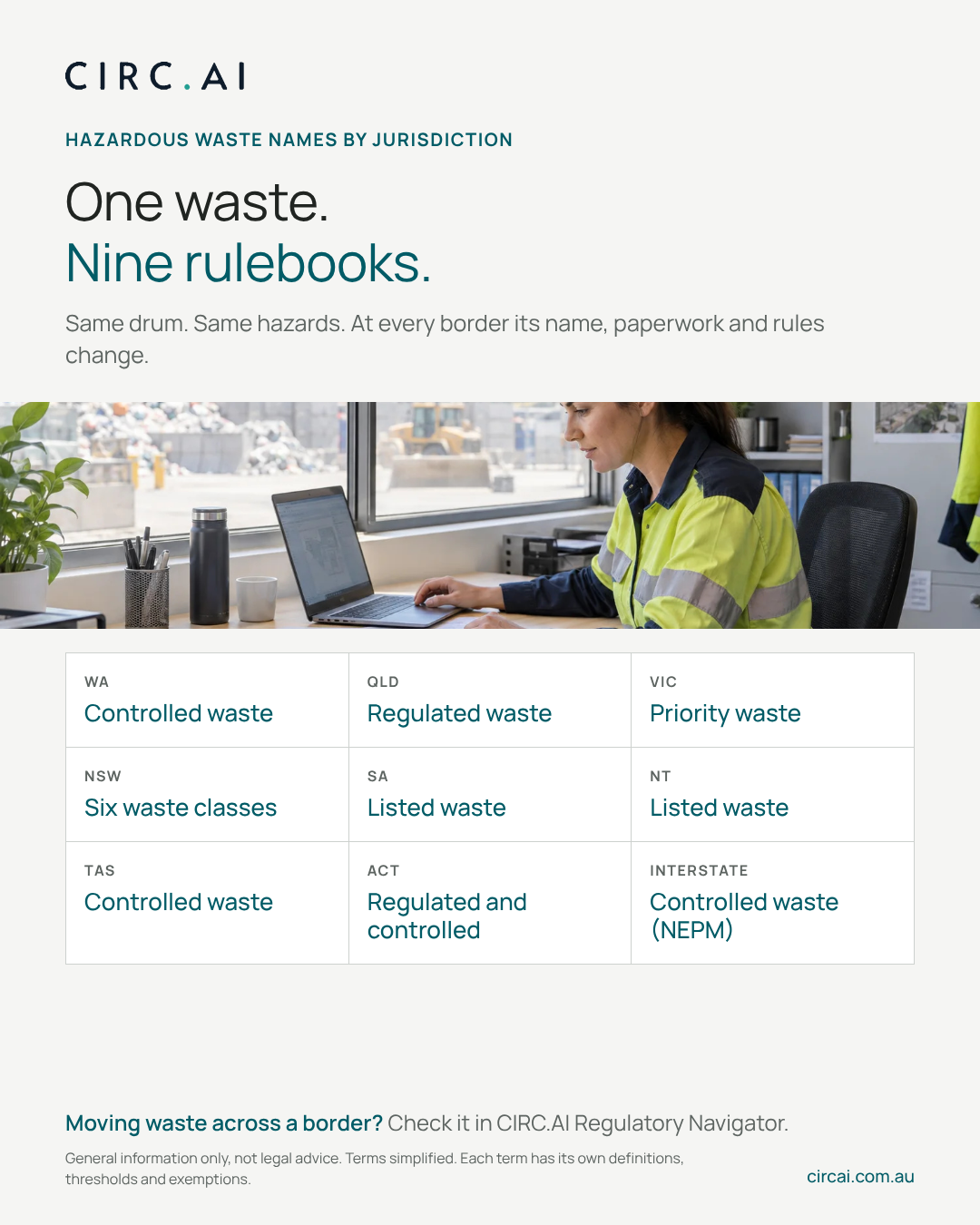
Picture a single drum of hazardous waste. Same contents, same hazards, same risk to people and the environment.
Now put it on a truck and drive it around Australia. At every border its name, its paperwork and its rules change.
What is hazardous waste called in each state?
| Jurisdiction | What hazardous waste is called | What that means in practice |
|---|---|---|
| Western Australia | Controlled waste | Carriers are licensed, plus drivers and vehicles for bulk loads. Tracking is mainly electronic. [1] |
| Queensland | Regulated waste (category 1 or 2) | A separate trackable waste list (Schedule 2E) decides what must be tracked. [2, 3] |
| Victoria | Priority waste and reportable priority waste | Most reportable priority waste is recorded in Waste Tracker each time it changes hands. [4] |
| New South Wales | Six waste classes, including hazardous, restricted solid, liquid and special waste | Whether waste must be tracked is a separate test. [6] |
| South Australia | Listed waste | Interstate moves also use “controlled waste” categories and a transport certificate. [7, 8] |
| Northern Territory | Listed waste | Licensed handlers report the listed waste they handle each year. [9, 10] |
| Tasmania | Controlled waste | Controlled waste transporters must be registered. [12] |
| ACT | Regulated waste and controlled waste | Both definitions can apply to the same material. [14] |
| Across borders | Controlled waste (national NEPM) | Each move needs a consignment authorisation from the destination, plus a transport certificate. [11] |
That’s nine rulebooks for one drum.
How do the hazardous waste rules differ?
Different words alone would only be a nuisance. The real issue is that each term comes with its own definitions, thresholds and exemptions.
- Thresholds differ. Victoria’s transport duty for reportable priority waste doesn’t apply to loads under 50 kg or litres carried for no fee or reward. [5] Queensland exempts non-commercial loads under 250 kg from tracking. [15] WA tracks packaged controlled waste only from 200 kg or litres. [1]
- Tracking differs. Victoria records most reportable priority waste at every hand-over. [4] Queensland tracks only waste on its trackable list. [3] In the NT, moves within the Territory also need a consignment authorisation. [11]
- Defaults differ. In NSW, waste that hasn’t been classified another way, and isn’t chemically assessed, must be treated as hazardous. [6]
Take asbestos. It is “special waste” in NSW [6] and “reportable priority waste” in Victoria [16]. In South Australia it is on the listed waste schedule. [7] In Queensland, even a load holding only asbestos residues must be tracked. [26]
Is the same waste hazardous in every state?
No. The same waste can be classified differently on each side of a border. Researched examples include batteries and tyres.
- Batteries. Most business battery waste is pre-classified as priority waste in Victoria. [17] NSW pre-classifies business lead-acid and nickel-cadmium batteries as hazardous. Lithium-ion batteries aren’t on that list, so they must be classified. [6] South Australia bans lead-acid batteries from landfill. [25]
- Tyres. Waste tyres are “special waste” in NSW [6], and loads over 200 kg or 20 tyres must be tracked. [18] In Queensland, tyres are trackable waste under code T140. [3] South Australia bans whole tyres from landfill. [25]
Do you need a different permit to transport waste in each state?
Yes. Each jurisdiction licenses hazardous waste transport in its own way. Researched examples include:
- NSW. An environment protection licence covers loads over 200 kg of certain wastes. [18]
- Victoria. High-risk reportable priority waste needs an A10a permit. Other reportable priority waste needs an A10b registration. [4]
- Western Australia. Carriers need a controlled waste carrier licence. Bulk loads also need licensed drivers and vehicles or tanks. [1]
- Queensland. Transporters may need an environmental authority for regulated waste transport (ERA 57). [19]
- South Australia. Waste transporters need an EPA licence. [20]
- Tasmania. Controlled waste transporters must be registered. [12]
- Northern Territory. Transporting listed waste requires an environment protection licence. [21]
- ACT. We found no separate transporter licence in the ACT guidance we reviewed. Controlled waste crossing the border needs a consignment authorisation. [28]
Are waste codes the same in every state?
Not quite. Many codes look the same across Australia because they come from the national hazardous waste reporting standard. Tasmania treats that list as an update to the controlled waste list in the national NEPM. [13]
So N220 means asbestos in Tasmania, Queensland and Victoria, and T140 means tyres in Tasmania and Queensland. [3, 13, 22, 23] But the same code doesn’t mean the same rules. Each state decides how a coded waste is classified, tracked and moved.
| Waste | National code and name | Victoria | NSW | Queensland |
|---|---|---|---|---|
| Asbestos | N220 “Asbestos” [13] | N220. Reportable priority waste. [23] | “Special waste”. Loads over 100 kg, or 10 m² of sheeting, are tracked. [6, 18] | Trackable waste under N220, even residues. [3, 26] |
| Tyres | T140 “Tyres” [13] | Shredded tyres (T141) are reportable priority waste, for transaction tracking only. [23] | “Special waste”. Loads over 200 kg, or 20 tyres, are tracked. [6, 18] | Trackable waste under T140. [3] |
| Contaminated soil | N120 “Soils contaminated with a controlled waste” [13] | N120 covers soil above fill limits or containing asbestos. Reportable priority waste. [23] | Classified into one of six classes, by testing if needed. [6] | Not on the trackable waste list. Its regulated waste category can depend on testing. [3, 24] |
| Batteries | No battery code [13] | Most business battery waste is pre-classified as priority waste. [17] | Business lead-acid and nickel-cadmium batteries are pre-classified as hazardous. [6] | No battery entry on the trackable waste list. [3] |
Researched examples of other differences include:
- Some states don’t use codes. WA’s controlled waste list uses plain-text names, with no codes. [27]
- Others rely on the national categories. South Australia, the NT and the ACT apply the national controlled waste categories to interstate movements. [8, 11, 14]
- Some add their own codes. Tasmania adds K130 for sewage sludge and DEADF for dead farmed fish. [13]
- The same code can carry a different status. Food waste code K200 is trackable waste in Queensland. [3] In Victoria, K200 liquid commercial food waste is priority waste. [23]
- Some codes are split. Victoria splits sludges into T130-H, a reportable priority waste, and T130-NH, a priority waste. [23]
- Codes change over time. On 1 July 2021, Victoria merged three contaminated soil codes into N120. [23]
- Codes drive other rules. In Victoria, the code decides whether transport needs an A10a permit or an A10b registration. [4]
A waste code is not a passport. Check what your code means in every jurisdiction your waste passes through.
Who is most affected?
- Multi-site businesses. A manufacturer, retailer or builder with sites in several states runs several systems for the same waste.
- Projects near borders. Construction, mining and infrastructure projects often send waste to the nearest suitable facility, which may be interstate.
- Contractors and transporters. Every new state means new licences, new forms and new rules.
- Anyone relying on one expert. When the person who knows all nine rulebooks moves on, the knowledge often goes with them.
How to manage hazardous waste across borders
- Map each waste to each state’s term and code. Don’t assume “hazardous” means the same thing everywhere.
- Classify using the local process. Each state has its own guidelines.
- Check before crossing a border. Interstate moves of controlled waste need a consignment authorisation from the destination.
- Keep one record, whatever the system. Your evidence shouldn’t depend on which portal a state uses.
Frequently asked questions
What is controlled waste in Western Australia?
WA regulates hazardous waste as controlled waste under the Environmental Protection (Controlled Waste) Regulations 2004. Carriers must be licensed, and drivers and vehicles carrying bulk loads also need licences. Loads are tracked mainly through an electronic system. [1]
What is regulated waste in Queensland?
Regulated waste is waste of a type listed in the Environmental Protection Regulation 2019. It is category 1 (highest risk) or category 2 (moderate risk). [2]
What is reportable priority waste in Victoria?
It is the highest-risk group of priority waste under the Environment Protection Act 2017. Most of it must be recorded in Waste Tracker every time it changes hands, and transported under an EPA permission. [4]
What is listed waste in South Australia and the Northern Territory?
It is the term both use for wastes that need special management. In SA, listed wastes are in Schedule 1 Part B of the Environment Protection Act 1993. [7] In the NT, they are prescribed in the waste management regulations. [9]
Do I need approval to move hazardous waste interstate?
Yes. Under the national controlled waste NEPM, each movement needs a consignment authorisation from the receiving jurisdiction and a waste transport certificate. [11]
Are waste codes the same in every state?
Many codes come from a national list, but each state decides how a coded waste is classified, tracked and moved. Some states add their own codes, and WA uses names instead of codes.
How CIRC.AI helps
Translating one waste stream into nine sets of rules is exactly the problem CIRC.AI was built to solve.
CIRC.AI is independent of the facilities and transport providers you need to compare.
- Regulatory Navigator shows the legal requirements for a waste in plain English, across every state and territory and Commonwealth law. Its library covers over 290 laws, regulations, codes and official guidance documents. Each requirement links to the clause behind it.
- Facility Finder will help you find licensed waste facilities and explore potential recovery pathways. It is free for waste generators to use.
- Track & Trace keeps waste movements, supporting documents and final-fate evidence together, with gaps visible.
- CIRC Advisory provides hands-on waste management consulting and assurance.
Check the rules for your waste in every state and territory before it moves. Use Regulatory Navigator.
Related reading
- Australia’s waste rules are a mess. Doing the right thing shouldn’t be this hard.
- Your waste. Your liability: what every waste generator must do
- Asbestos in Australia: how to identify, test, remove and dispose of it
- Lithium-ion batteries: the fire risk hiding in your waste stream
References
[1] WA Government – Controlled waste. wa.gov.au
[2] Business Queensland – Regulated waste classification. business.qld.gov.au
[3] Business Queensland – List of trackable waste. business.qld.gov.au
[4] EPA Victoria – Transport industrial waste. epa.vic.gov.au
[5] EPA Victoria – Duty of persons transporting reportable priority waste. epa.vic.gov.au
[6] NSW EPA – Waste Classification Guidelines Part 1. epa.nsw.gov.au
[7] SA Legislation – Environment Protection Act 1993 (Schedule 1 Part B). legislation.sa.gov.au
[8] SA Government Gazette – Environment Protection (Movement of Controlled Waste) Policy 2014. governmentgazette.sa.gov.au
[9] NT EPA – Waste. ntepa.nt.gov.au
[10] NT EPA – Licensing and approvals. ntepa.nt.gov.au
[11] NT EPA – Guidelines for the movement of controlled waste. ntepa.nt.gov.au
[12] EPA Tasmania – Registration of controlled waste transporters. epa.tas.gov.au
[13] EPA Tasmania – Controlled waste category codes. epa.tas.gov.au
[14] ACT – Environment Protection (Hazardous Materials) Environment Protection Policy 2022. legislation.act.gov.au
[15] Business Queensland – Waste tracking exemptions. business.qld.gov.au
[16] Victorian Government – Asbestos environment laws and guidance. asbestos.vic.gov.au
[17] EPA Victoria – About e-waste. epa.vic.gov.au
[18] Transport for NSW – Waste management guideline (2023). transport.nsw.gov.au
[19] Business Queensland – Management of regulated waste. business.qld.gov.au
[20] SA Law Handbook – Waste. lawhandbook.sa.gov.au
[21] NT Government – Listed waste transporters a key focus for the regulator. environment.nt.gov.au
[22] EPA Victoria – Waste codes. epa.vic.gov.au
[23] EPA Victoria – Waste code transition to the Environment Protection Regulations 2021. epa.vic.gov.au
[24] Holding Redlich – Queensland’s regulated waste classification framework. holdingredlich.com
[25] SA Legislation – Environment Protection (Waste to Resources) Policy 2010, Schedule 4. legislation.sa.gov.au
[26] Business Queensland – Transport of asbestos and lead acid batteries. business.qld.gov.au
[27] WA Environmental Protection (Controlled Waste) Regulations 2004. legislation.wa.gov.au
[28] WorkSafe ACT – Transport of waste containing asbestos. worksafe.act.gov.au
This article is general information only and is not legal advice. Requirements vary by jurisdiction, site and waste type. Always confirm your specific obligations with the relevant regulator or a qualified adviser.