
Out of sight is not out of liability

By Kim Horwood, Director, CIRC.AI. Environmental scientist with 20+ years in waste regulation.
· 11 min read · Current as at November 2026
The short answer: When waste leaves your site, it is still your waste. In NSW, for example, the owner commits an offence if it goes somewhere that cannot lawfully accept it. Before each load leaves, confirm the destination is authorised and can handle the volume. Then keep records that prove where it went.
Key takeaways
- When waste leaves your site, it is still your waste. A contract or a copy of a licence proves very little.
- The biggest risk is stranded waste: your material left on a closed, burnt-out or insolvent site.
- Overseas, generators pay directly for clean-ups, and regulators make operators set money aside.
- In Australia, a facility’s financial assurance protects the public, not you.
- Know where every load went, and keep the records that prove it.
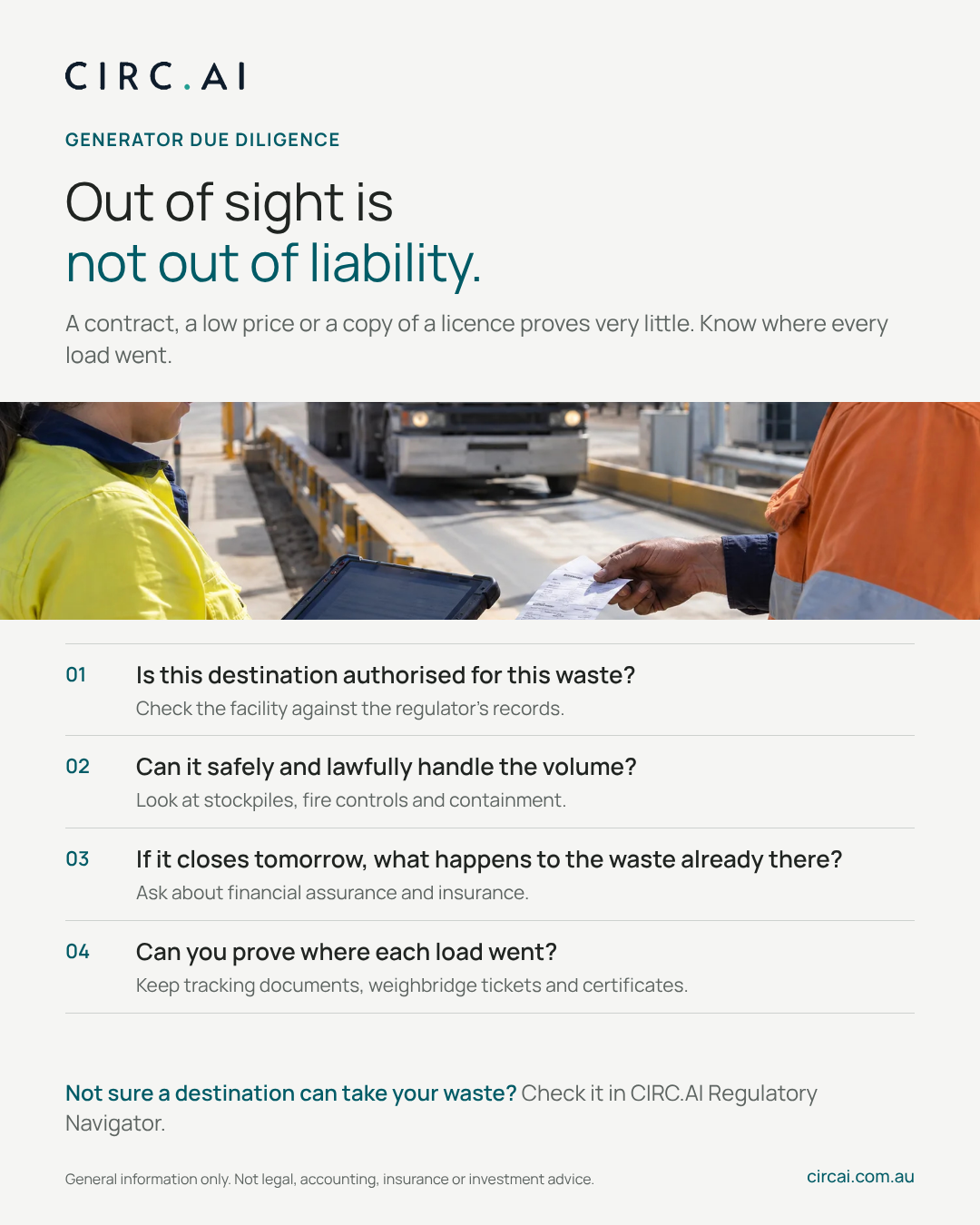
When your waste leaves site, it is still your waste. You chose where it went, and you are relying on a chain of people to handle it properly.
A contract, a low price or a copy of a licence proves very little. None of them shows that each load was lawfully accepted, or that the waste was treated as promised.
The biggest risk is often stranded waste. That is your material, sitting on a closed, burnt-out or insolvent site, with your project, your records and your name attached.
Why the generator has to care
A failure downstream can come back to the business that produced the waste. Depending on where you are, you may have duties to classify, track and transport waste lawfully, and to send it to a lawful destination. Examples include NSW, where the owner of waste commits an offence if it goes to a place that cannot lawfully accept it. [19] In Victoria, anyone managing industrial waste must take reasonable steps to check it is going somewhere lawful. [35]
The practical risk is real, even without a prosecution:
- A regulator asks where your waste went.
- A customer suspends a project.
- A new contractor refuses mixed or unidentified material.
- Your insurer disputes cover.
- You pay to move and dispose of the same waste twice, and the failed operator’s indemnity is worth little.
When facilities fail, the damage spreads
United States. In April 2023, warehouses storing recycled plastic burned in Richmond, Indiana. The US EPA began a clean-up estimated at US$2.8 million, collecting fire debris from 330 properties and 28 public rights-of-way. Debris samples contained asbestos. [1]
France. On 17 February 2024, fire broke out at a lithium battery recycling facility in Viviez. The storage building held around 1,076 tonnes of batteries. [2] A “recycling” label tells you nothing about whether a site can safely handle your waste.
Overseas, generators pay and money is set aside
United States. Under the Superfund law, generators who arranged disposal of hazardous substances are one of four groups who can be liable for a clean-up. The others are site owners, operators and transporters. Liability is strict, joint and several, and retroactive, and following industry practice is no defence. [3] When no responsible party can pay, the Superfund Trust Fund steps in. The chemical taxes that help fund it were reinstated in 2022 at double the previous rate. [4]
Generators also pay penalties directly. In 2011, Target settled for US$22.5 million after hazardous products from more than 290 Californian stores and distribution centres went into compactors or down drains. [5] In October 2024, Walmart agreed to pay US$7.5 million, without admitting wrongdoing, after audits found hazardous waste in municipal landfills. [6]
Europe. The EU’s Environmental Liability Directive makes operators prevent and remedy the environmental damage they cause. [7] Several member states make financial security for this compulsory. Researched examples include Spain, Portugal and Ireland. [8] Landfill operators must have financial security for closure and after-care before disposal starts. [9] Some cross-border waste shipments also need a financial guarantee before they move. [10]
In 2010, a Dutch court fined Trafigura €1 million for illegally exporting its own chemical waste from Amsterdam. Its harmful nature was concealed, and it was later dumped in Côte d’Ivoire. [11]
Expectations are rising too. The EU’s corporate sustainability due diligence rules require the largest companies to check environmental risks in their business relationships. [12] Most Australian generators aren’t covered directly, but suppliers to those companies can expect questions about where their waste goes.
Australia: the assurance protects the public, not you
Regulators in several states and territories can require financial assurance from licensed facilities, usually a bank guarantee or bond. For example, NSW can make it a licence condition, and EPA Victoria can require it for certain waste activities. [13, 14]
That money secures the facility’s obligations to the regulator. It is not a fund for your waste, and it may not cover the full cost if a site fails. If waste is traced back to you, the cost can still land with you.
So ask before you send. Does this facility hold financial assurance or insurance? How much? Is it enough for what is on site?
When the operator collapses, liability travels back up the chain
NOGA and the Northern Endeavour. Northern Oil and Gas Australia (NOGA) bought the Laminaria–Corallina oil fields and the Northern Endeavour floating production facility in 2016. Operations were shut down in 2019, NOGA went into liquidation, and the Commonwealth took over decommissioning. Offshore producers now pay a levy of A$0.48 per barrel of oil equivalent to recover the cost. [15]
The response was “trailing liability”. Since March 2022, the regulator can call back former titleholders and their related companies to decommission. [17]
Cliff Head, WA. Pilot Energy entered voluntary administration on 14 July 2026, and its joint venture partner Triangle Energy followed on 21 July. The Cliff Head field off Dongara still needs decommissioning. One law firm puts the liabilities at around $200 million, but does not say who made that estimate. [16] Who pays is not yet clear.
WA’s pooled fund. WA took a different approach for mining. Most tenement holders pay into the Mining Rehabilitation Fund, which rehabilitates abandoned mine sites. [18]
Waste generators should recognise the pattern. When the last operator in the chain fails, regulators look back up the chain. If that ends in a levy or pooled fund, everyone pays for a few failures.
What Australian cases show
Researched examples include:
- Silverdale to Wyong, NSW. Two related companies were ordered to pay $57,000. One supplied falsified dockets for 1,033 tonnes of asbestos waste, some of which sat at a site that could not lawfully receive it. [21]
- Waterloo, NSW. A construction contractor was fined $40,000 for 68 falsified dockets claiming 990 tonnes went to an approved facility. [22]
- Darwin, NT. A developer and his company were fined $300,000 for failing to comply with pollution abatement notices covering around 15,000 tonnes of waste, including asbestos and PFAS-contaminated soil. [23]
- East Rockingham, WA. A construction company and an individual were fined $115,000 after five loads of dirt and green waste were dumped on a road reserve. [24]
These cases don’t make every generator liable for a contractor’s offence. They do show what regulators look at: who owned the waste, what instructions were given, where the loads went, and whether the records were genuine. A signed docket can be false. Your records should show where the waste actually went.
What generator due diligence should cover
- Define the waste. Classify it, identify hazards, separate incompatible streams and estimate volumes.
- Verify the destination. Check the facility against the regulator’s records, and confirm its approval covers your waste, quantities and storage.
- Follow every load. Keep tracking documents, weighbridge tickets and certificates. Reconcile invoices against what was received.
- Inspect capability. Visit higher-risk sites. Look at stockpiles, fire controls and containment, and check for recent notices.
- Check the money behind the site. Ask what financial assurance and insurance it holds, and watch for rising stockpiles.
- Write contracts that work. Require accurate reporting, audit rights and notice of incidents. Ban unapproved destinations and subcontracting.
- Keep monitoring. Reconcile monthly, recheck approvals, and stop sending waste if anything is in doubt.
In WA, for example, a waste holder must use a carrier licensed for that type of controlled waste and keep the driver’s receipt for at least three years. [20]
Don’t forget the balance sheet
Under AASB 137, a provision is needed when there is a present obligation from a past event, an outflow is probable, and the amount can be reliably estimated. The standard uses clean-up of unlawful environmental damage as an example. [25] A facility failure doesn’t automatically create a provision for the generator, but it may need to be assessed or disclosed as a contingent liability.
US rules (ASC 410-30) are more explicit. A company that arranged disposal at a contaminated site records the liability once it is probable and can be estimated. [26]
Before you authorise a load
Answer three questions, with records:
- Is this destination authorised for this waste?
- Can it safely and lawfully handle the volume?
- If it closes tomorrow, what happens to the waste already there?
Frequently asked questions
How does waste tracking work?
Where tracking is required, hazardous waste is tracked from the generator, through the transporter, to the receiving facility. Each party completes its part of the record. Interstate moves also need a consignment authorisation under the national rules. [32] Each state runs its own system. Researched examples include:
- Victoria. Most reportable priority waste is recorded in Waste Tracker at every hand-over. [27]
- NSW. Hazardous waste uses the EPA’s online system, while asbestos and tyres are tracked in WasteLocate. [28] NSW and Queensland are building a shared tracking system. [29]
- Queensland. Trackable regulated waste is recorded through the state’s waste tracking system. [36]
- South Australia. Listed waste must be tracked into, within and out of the state, with a transport certificate. [37] Using the EPA’s online WasteTracker is not compulsory. [30]
- Western Australia. Controlled waste is tracked mainly through an electronic system. [31]
- Tasmania. Interstate moves follow the national rules. [38] We could not confirm from EPA Tasmania’s pages how movements within Tasmania are tracked.
- Northern Territory. Tracking within the Territory has been required since 1 July 2021. [32] Licensed handlers use the NT EPA’s online tracking portal. [39]
- ACT. ACT asbestos guidance says waste must not cross the border without a controlled waste consignment authorisation. [40] We found no separate ACT tracking system.
Am I still responsible for my waste after a contractor collects it?
In many cases, yes. You can be liable if your waste ends up somewhere unlawful, so keep records that show its final fate.
What is stranded waste?
Waste left on a closed, burnt-out or insolvent site. If it can be traced back to you, the cost and reputational damage can follow.
Who pays the waste levy?
Facilities that receive waste usually pay it to the state, and pass it on through disposal fees. In NSW, for example, certain licensed waste facilities pay for each tonne received. [33] In Queensland, landfill operators pay it and may recover it through gate fees. [34]
How CIRC.AI helps
The rules for your waste depend on what it is and where it goes. CIRC.AI’s tools help you get it right before a load leaves site.
CIRC.AI is independent of the facilities and transport providers you need to compare.
- Regulatory Navigator shows the legal requirements for a waste in plain English, across every state and territory and Commonwealth law. Its library covers over 290 laws, regulations, codes and official guidance documents. Each requirement links to the clause behind it.
- Facility Finder will help you find licensed waste facilities and explore potential recovery pathways. It is free for waste generators to use.
- Track & Trace keeps waste movements, supporting documents and final-fate evidence together, with gaps visible.
- CIRC Advisory provides hands-on waste management consulting and assurance.
Check before you send. Use Regulatory Navigator.
Related reading
- Your waste. Your liability: what every waste generator must do
- Australia’s waste rules are a mess. Doing the right thing shouldn’t be this hard.
- What a good waste management plan includes
References
[1] U.S. EPA – My Way Trading warehouse fire clean-up, Richmond, Indiana. epa.gov
[2] ARIA record 61711 – battery recycling storage fire, Viviez, 17 February 2024. aria.developpement-durable.gouv.fr
[3] U.S. EPA – Superfund liability. 19january2021snapshot.epa.gov
[4] Baker Botts – Infrastructure Act reinstates and doubles one of three expired Superfund taxes. bakerbotts.com
[5] Placer County – Target stores must pay $22.5 million for environmental violations (March 2011). placer.ca.gov
[6] California Attorney General – Walmart to pay $7.5 million (October 2024). oag.ca.gov
[7] Directive 2004/35/EC on environmental liability. legislation.gov.uk
[8] Ecologic Institute – Improving financial security under the Environmental Liability Directive (2020). ecologic.eu
[9] Council Directive 1999/31/EC on the landfill of waste, Article 8. legislation.gov.uk
[10] Regulation (EU) 2024/1157 on shipments of waste. eur-lex.europa.eu
[11] DutchNews – Trafigura fined €1m for exporting toxic waste from Amsterdam (July 2010). dutchnews.nl
[12] European Commission – Corporate sustainability due diligence. commission.europa.eu
[13] NSW EPA – Financial Assurance Policy (May 2022). epa.nsw.gov.au
[14] EPA Victoria – Financial assurances and waste and resource recovery facilities. epa.vic.gov.au
[15] Australian Government DISR – Offshore petroleum cost recovery levy. industry.gov.au
[16] Clyde & Co – Triangle Energy’s collapse: Northern Endeavour 2.0? (September 2026). clydeco.com
[17] NOPSEMA – Trailing liability provisions now in effect. nopsema.gov.au
[18] WA Government – About the Mining Rehabilitation Fund. wa.gov.au
[19] NSW Legislation – Protection of the Environment Operations Act 1997 (s 143). legislation.nsw.gov.au
[20] WA Environmental Protection (Controlled Waste) Regulations 2004 (reg 25). legislation.wa.gov.au
[21] NSW EPA – Central Coast companies to pay $57,000 for waste offences (April 2025). epa.nsw.gov.au
[22] NSW EPA – EPA issues fine for falsified waste records (December 2025). epa.nsw.gov.au
[23] NT EPA – Local businessman convicted under the Waste Management and Pollution Control Act 1998 (2021). ntepa.nt.gov.au
[24] WA Government – Covert camera catches dirt dumper, resulting in big fines. wa.gov.au
[25] AASB 137 Provisions, Contingent Liabilities and Contingent Assets. legislation.gov.au
[26] Deloitte – Recognition of environmental remediation liabilities (ASC 410-30). dart.deloitte.com
[27] EPA Victoria – Transport industrial waste. epa.vic.gov.au
[28] Transport for NSW – Waste management guideline (WasteLocate). transport.nsw.gov.au
[29] NSW EPA – Integrated Waste Tracking Solution. epa.nsw.gov.au
[30] SA EPA – Online waste tracking. epa.sa.gov.au
[31] WA Government – Controlled waste. wa.gov.au
[32] NT EPA – Guidelines for the movement of controlled waste. ntepa.nt.gov.au
[33] NSW EPA – Waste levy. epa.nsw.gov.au
[34] Gladstone Regional Council – What the waste levy means for businesses (Qld). gladstone.qld.gov.au
[35] EPA Victoria – Duty of persons involved in transporting industrial waste. epa.vic.gov.au
[36] Business Queensland – Waste tracking obligations. business.qld.gov.au
[37] SA EPA – WasteTracker: tracking and transporting waste. epa.sa.gov.au
[38] EPA Tasmania – Interstate movements of controlled waste. epa.tas.gov.au
[39] NT EPA – Waste tracking. ntepa.nt.gov.au
[40] WorkSafe ACT – Transport of waste containing asbestos. worksafe.act.gov.au
This article is general information only and is not legal advice. Requirements vary by jurisdiction, site and waste type. Always confirm your specific obligations with the relevant regulator or a qualified adviser.