
Asbestos in Australia: how to identify, test, remove and dispose of it

By Kim Horwood, Director, CIRC.AI. Environmental scientist with 20+ years in waste regulation.
· 9 min read · Current as at November 2026
The short answer: You can’t identify asbestos by looking. Only a NATA-accredited laboratory can confirm it. Friable asbestos needs a Class A removalist, and more than 10 m² of bonded asbestos needs a licence. Asbestos waste must be wrapped, labelled and taken only to a site authorised to accept it. Tracking, transport and labelling rules differ by state.
Key takeaways
- You can’t identify asbestos by looking at it. Only a NATA-accredited laboratory test can confirm it.
- Friable asbestos must be removed by a Class A licence holder. More than 10 m² of bonded asbestos also needs a licence.
- Many workplaces built before 31 December 2003 need an asbestos register.
- Asbestos waste must be wrapped, labelled and taken only to a site authorised to accept it.
- Each state handles asbestos waste differently, from tracking to transport to levies.
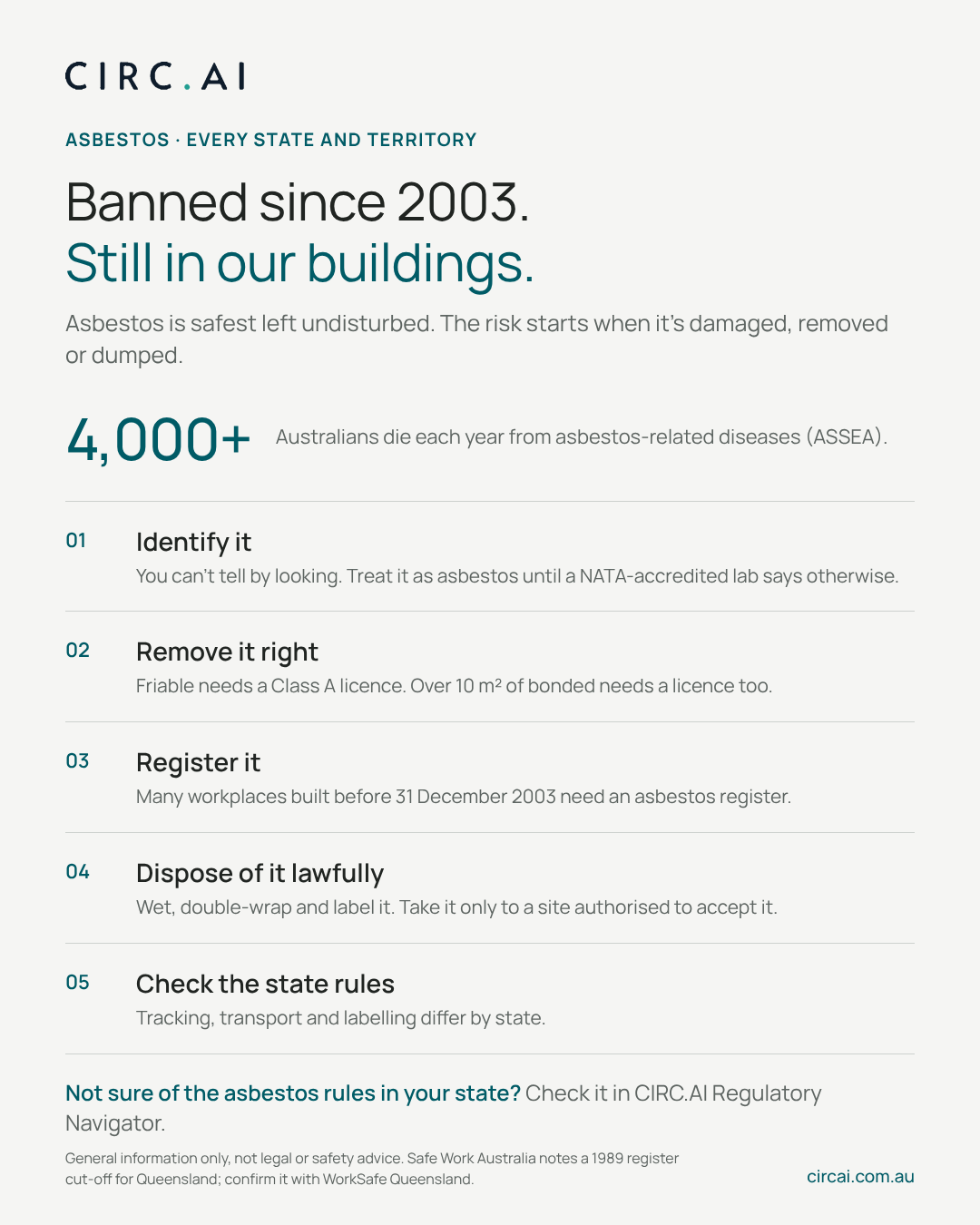
Asbestos was banned across Australia from 31 December 2003, yet it is still in many homes, workplaces and buildings. More than 4,000 Australians die each year from asbestos-related diseases, according to the Asbestos and Silica Safety and Eradication Agency. [1]
Asbestos is safest when it is left alone. The risk starts when it is damaged, removed or dumped, which makes every renovation, demolition and clean-up a waste issue too.
What is asbestos and how do you identify it?
Asbestos is a group of natural mineral fibres. It was widely used in building products because it is strong and fire resistant. Houses built before 1990 commonly contain it. [2]
Researched examples of where it is found include: [3]
- fibro sheeting on walls, ceilings and roofs
- vinyl floor tiles, compressed cement flooring and carpet underlay
- hot water pipe insulation and fireplace flues
- switchboards, gutters, downpipes and roof fixings
- sheds, garages, and soil where old buildings were demolished.
What does asbestos look like?
You can’t tell if a material contains asbestos just by looking at it. [2] Many products look the same with or without it, so if in doubt, treat it as asbestos until a test proves otherwise.
Asbestos comes in two forms. Bonded (non-friable) asbestos is fixed in a material such as cement sheeting. Friable asbestos is powdery, or can be crumbled by hand when dry, and releases fibres much more easily. [5]
How do you test for asbestos, and who can do it?
Laboratory testing is the only way to confirm asbestos, and the laboratory must be accredited by the National Association of Testing Authorities (NATA). [4] Samples should be taken by a competent person, such as a licensed asbestos assessor, an occupational hygienist or a licensed removalist. [2, 4]
Licensing for home inspections differs. In the ACT, for example, a residential asbestos assessment must be done by a licensed assessor. Elsewhere, no licence is needed for a residential inspection. [4]
What are the rules for asbestos removal?
Every state and territory regulates asbestos removal through its work health and safety laws (occupational health and safety laws in Victoria). The core rules are broadly the same nationally: [5]
- Friable asbestos must only be removed by a Class A licence holder.
- Removing more than 10 m² of bonded asbestos needs a Class B licence or higher.
- Waste must be contained and labelled before it leaves the removal area.
- Waste must be disposed of as soon as practicable at a site authorised to accept asbestos.
Rules for homeowners vary. In NSW, for example, homeowners can generally remove less than 10 m² of bonded asbestos themselves. [3] Check with your council or regulator first.
Which asbestos codes of practice apply?
Most jurisdictions use two codes of practice based on Safe Work Australia’s model codes: [5, 14]
- How to manage and control asbestos in the workplace covers identifying, recording and managing asbestos.
- How to safely remove asbestos covers licensed removal, containment and disposal.
Researched examples include NSW, Queensland, WA, South Australia, Tasmania and the NT. [15–20] Queensland’s versions are dated 2021. [16] South Australia adds an addendum on air monitoring for removal work. [18]
Victoria has its own two compliance codes: Managing asbestos in workplaces, and Removing asbestos in workplaces. [21, 22] ACT WorkSafe guidance also refers to the How to Safely Remove Asbestos code of practice. [33] Codes are updated over time, so check which version applies where you work.
Who needs an asbestos register?
A business that manages or controls a workplace must keep an asbestos register if asbestos is present or likely. This applies to workplaces built before 31 December 2003. [7] Safe Work Australia notes a different cut-off for Queensland: 31 December 1989. [6] We could not confirm this in Queensland’s own legislation, so check it with WorkSafe Queensland.
The register records the location, type and condition of all identified asbestos. [7] If asbestos is present, you also need an asbestos management plan, reviewed at least every five years. [6]
How do you dispose of asbestos?
Asbestos never goes in a household bin, a general waste skip or recycling, and it must never be dumped. Researched examples of good practice include: [5, 8–10]
- Keep it wet and wrap it. Double-wrap it in heavy-duty polythene about 0.2 mm (200 µm) thick.
- Label it. Mark every bag or package clearly as asbestos waste.
- Use the right transport. Commercial loads may need a permitted or licensed transporter, depending on the state.
- Take it only to an authorised site. Not every landfill accepts asbestos. Call ahead, as you may need to book.
- Track it where required. Tracking thresholds differ between states.
- Keep the records. Keep the receipt showing the waste reached an authorised site.
Do asbestos waste rules differ between states?
Yes. Asbestos is code N220 nationally [28], but each state handles it differently. Researched examples include:
- Victoria. Asbestos is reportable priority waste. [23] Household asbestos carried in your own vehicle needs no Waste Tracker record or permit, while business asbestos must go to a landfill authorised for it. [9]
- NSW. Asbestos is “special waste”. [24] Loads over 100 kg, or 10 m² of sheeting, must be tracked. [10]
- Queensland. Asbestos is trackable waste, even when a load holds only residues, and an asbestos removal licence does not let you transport it. [25] Some lawfully managed asbestos waste is exempt from the Queensland waste levy. [26]
- Western Australia. Asbestos is controlled waste, but the carrier licence and tracking form rules don’t apply. Loads must be labelled “CAUTION ASBESTOS” in letters at least 50 mm high. [27]
- South Australia. Asbestos is listed waste. Transporting it for fee or reward needs an EPA licence, but domestic transport does not. It must go to a licensed transfer station or waste depot. [30]
- Tasmania. Asbestos is controlled waste, and its transporters must be registered. [28, 29]
- Northern Territory. Asbestos is listed waste. Asbestos removed on a commercial basis must be carried by an environment protection licence holder. Householders don’t need one. [31]
- ACT. Commercial asbestos loads, and domestic loads over 250 kg, go to the Mugga Lane Resource Management Centre by appointment. [32] Asbestos waste must not cross the ACT border without a controlled waste consignment authorisation. [33]
Check the rules where the asbestos is removed and where it is going.
Why asbestos waste is a business risk
Asbestos waste stays your responsibility until it reaches its final fate, and regulators follow it through the whole chain. Researched examples include:
- The NSW EPA inspected more than 300 sites for asbestos in mulch and confirmed contamination at 79. [12]
- In December 2024, the EPA commenced prosecutions against three companies and one individual over that mulch. [11] At the time of writing, we found no court outcome, so these remain charges, not convictions.
- A NSW waste operator was fined $90,000 for false or misleading information about how asbestos waste was disposed of. [13] The EPA notice we found does not give the date of the fine.
Frequently asked questions
Can you tell if something is asbestos by looking at it?
No. Only a NATA-accredited laboratory test can confirm asbestos. [4]
Do I need a licence to remove asbestos?
You need a Class A licence for friable asbestos, and a Class B licence or higher for more than 10 m² of bonded asbestos. [5] Rules for smaller amounts vary between states and territories.
Which codes of practice apply to asbestos?
Most states and territories use two codes based on the national model codes: one for managing asbestos and one for removing it. Victoria has its own compliance codes.
Can I put asbestos in my wheelie bin?
No. Asbestos must be wrapped, labelled and taken to a site authorised to accept it.
Who needs an asbestos register?
Workplaces built before 31 December 2003 where asbestos is present or likely. [7] Safe Work Australia notes a 31 December 1989 cut-off for Queensland. [6]
Where can I dispose of asbestos near me?
Only at sites authorised to accept asbestos. Your council or state environmental regulator can tell you where they are. Call ahead before you go.
How CIRC.AI helps
Asbestos rules sit across work health and safety law and environmental law, and they differ between states and territories. CIRC.AI’s tools bring them together.
CIRC.AI is independent of the facilities and transport providers you need to compare.
- Regulatory Navigator shows the legal requirements for a waste in plain English, across every state and territory and Commonwealth law. Its library covers over 290 laws, regulations, codes and official guidance documents. Each requirement links to the clause behind it.
- Facility Finder will help you find licensed waste facilities and explore potential recovery pathways. It is free for waste generators to use.
- Track & Trace keeps waste movements, supporting documents and final-fate evidence together, with gaps visible.
- CIRC Advisory provides hands-on waste management consulting and assurance.
Check the rules before asbestos leaves your site. Use Regulatory Navigator.
Related reading
- One Waste, Nine Rulebooks: what hazardous waste is called in each state
- Your waste. Your liability: what every waste generator must do
- What a good waste management plan includes
References
[1] ASSEA – Workers’ Memorial Day media release (28 April 2025). asbestossafety.gov.au
[2] Asbestos in Victoria – Find and identify asbestos. asbestos.vic.gov.au
[3] NSW Government – Asbestos awareness fact sheet for homeowners. asbestos.nsw.gov.au
[4] ASSEA – Arranging a residential asbestos assessment. asbestossafety.gov.au
[5] Safe Work Australia – Model Code of Practice: How to safely remove asbestos. safeworkaustralia.gov.au
[6] Safe Work Australia – Asbestos: managing risks. safeworkaustralia.gov.au
[7] WorkSafe WA – Asbestos register and asbestos management plan. worksafe.wa.gov.au
[8] Asbestos in Victoria – Packaging, transport and disposal of asbestos. asbestos.vic.gov.au
[9] EPA Victoria – Dispose of asbestos waste. epa.vic.gov.au
[10] ABLIS – Tracking asbestos waste (NSW). ablis.business.gov.au
[11] NSW EPA – EPA commences prosecutions in the asbestos in mulch investigation (December 2024). epa.nsw.gov.au
[12] Law Society Journal – Court action over asbestos in mulch. lsj.com.au
[13] NSW EPA – Waste operator fined $90,000 over asbestos waste offences. epa.nsw.gov.au
[14] Safe Work Australia – Model Code of Practice: How to manage and control asbestos in the workplace. safeworkaustralia.gov.au
[15] SafeWork NSW – Asbestos codes of practice. safework.nsw.gov.au
[16] Queensland Government – Asbestos codes of practice. asbestos.qld.gov.au
[17] WorkSafe WA – How to manage and control asbestos in the workplace: code of practice. worksafe.wa.gov.au
[18] SafeWork SA – Codes of practice. safework.sa.gov.au
[19] WorkSafe Tasmania – How to manage and control asbestos in the workplace. worksafe.tas.gov.au
[20] NT WorkSafe – How to manage and control asbestos in the workplace. worksafe.nt.gov.au
[21] WorkSafe Victoria – Compliance code: Managing asbestos in workplaces. worksafe.vic.gov.au
[22] WorkSafe Victoria – Compliance code: Removing asbestos in workplaces. worksafe.vic.gov.au
[23] Victorian Government – Asbestos environment laws and guidance. asbestos.vic.gov.au
[24] NSW EPA – Waste Classification Guidelines Part 1. epa.nsw.gov.au
[25] Business Queensland – Transport of asbestos and lead acid batteries. business.qld.gov.au
[26] Queensland Government – Exempt waste (waste levy). qld.gov.au
[27] WA Government – Controlled waste fact sheet 13: Asbestos. wa.gov.au
[28] EPA Tasmania – Controlled waste category codes. epa.tas.gov.au
[29] EPA Tasmania – Registration of controlled waste transporters. epa.tas.gov.au
[30] SA Government – Asbestos and the law. asbestos.sa.gov.au
[31] NT Government – Transport and disposal of asbestos waste. asbestos.nt.gov.au
[32] WorkSafe ACT – Asbestos disposal options. worksafe.act.gov.au
[33] WorkSafe ACT – Transport of waste containing asbestos. worksafe.act.gov.au
This article is general information only and is not legal advice. Requirements vary by jurisdiction, site and waste type. Always confirm your specific obligations with the relevant regulator or a qualified adviser.