
What a good waste management plan includes

By Kim Horwood, Director, CIRC.AI. Environmental scientist with 20+ years in waste regulation.
· 4 min read · Current as at November 2026
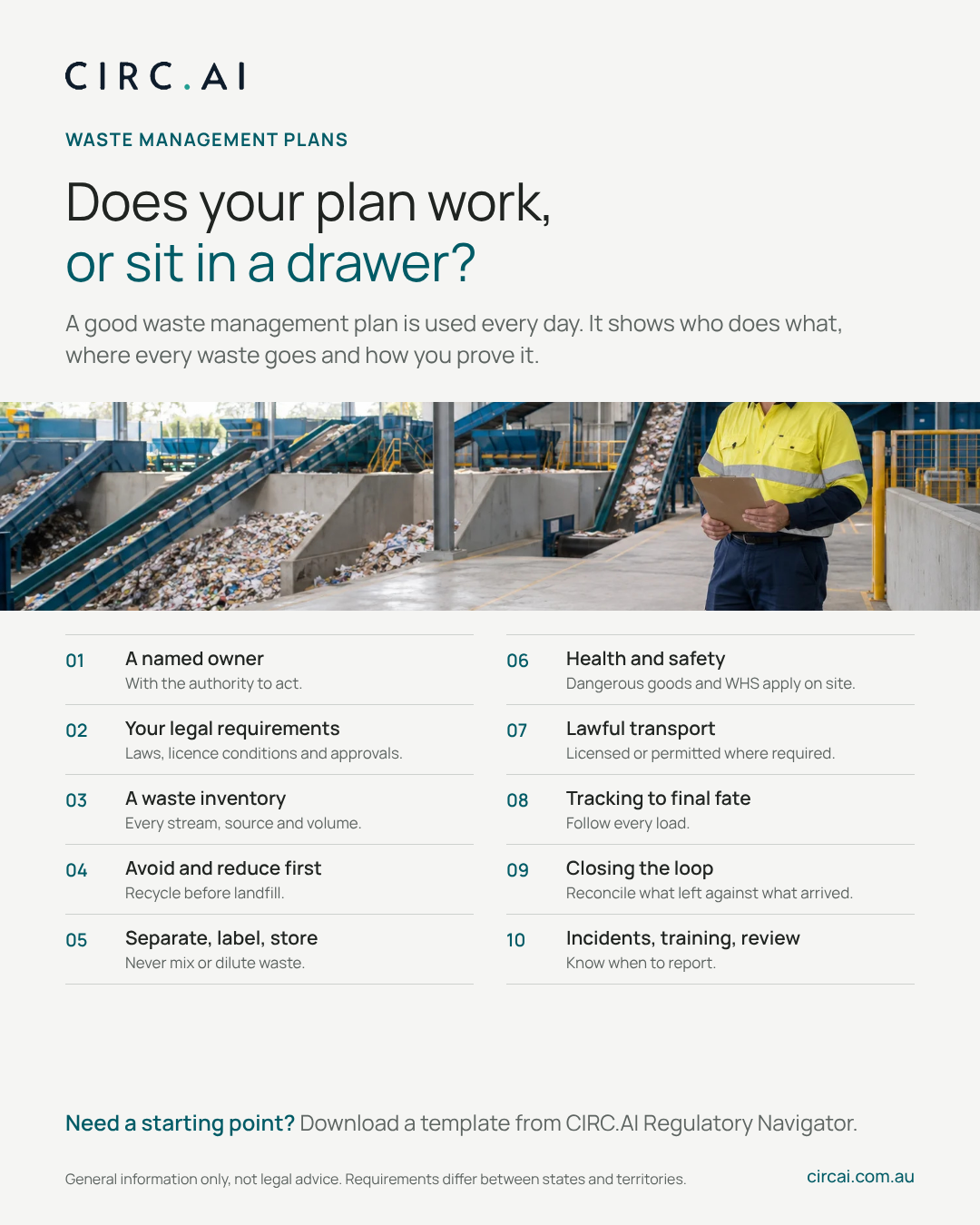
The short answer: A good waste management plan names an owner and lists your legal requirements and every waste stream. It shows how you avoid, separate, store, transport and track waste to its final fate. It also covers monthly reconciliation, incidents, training and review. Councils, licences and some mining approvals can require one.
Does your waste management plan work, or does it sit in a drawer?
When do you need a waste management plan?
Every site that generates waste should have a plan for it. Many approvals can require one, and the triggers differ between jurisdictions. Researched examples include:
- Council approvals. NSW councils can require site waste management plans with development applications. [1] North Sydney, for example, requires one with every application involving demolition or construction. [2]
- Mining approvals. In the NT, some environmental mining licence applications need a waste discharge management plan. This applies where the activity will discharge waste to water. [3]
- Licence conditions. Environmental licences can include waste management conditions, so check yours.
A plan that sits in a drawer protects no one. A good plan is used every day. It shows who does what, where every waste goes, and how you prove it.
What should a waste management plan include?
Researched good practice points to ten elements:
- A named owner. Say which site and activities the plan covers. Name the person accountable, and give them the authority to act.
- Your legal requirements. List the laws, licence conditions and approvals that apply to your site. They differ between states and territories.
- A waste inventory. List every waste stream, its source and its expected volume. Flag which are hazardous waste or dangerous goods.
- Avoid and reduce first. Show how you will avoid waste, reuse it and cut volumes. Recycle or repurpose before landfill or incineration.
- Separate, label and store safely. Keep streams apart and never mix or dilute waste. Label every container, keep labels readable, and store incompatible wastes apart.
- Health and safety. Know the risks your waste poses to your people. Dangerous goods and work health and safety rules apply on site, not just in transport. [4]
- Lawful transport and destinations. Use transporters licensed or permitted for your waste where the law requires it. Each jurisdiction does this differently. Researched examples include NSW environment protection licences [8], Victoria’s A10a permits [5], Queensland’s ERA 57 environmental authority [9] and WA’s controlled waste carrier licences. [6] SA requires an EPA licence [10], Tasmania registers transporters [11] and the NT requires an environment protection licence. [12] In the ACT, we found no separate transporter licence in the guidance we reviewed. Send waste only to a facility approved to accept it.
- Tracking to final fate. Complete your part of every manifest or tracking record. Follow each load until it is recycled, treated or disposed of.
- Closing the loop. Each month, reconcile what left site against what facilities confirm they received. Close out every load with evidence.
- Incidents, training and review. Set out how to respond to spills and when to report incidents. The triggers vary: the NT, for example, requires notice of incidents causing or threatening material or serious harm. [7] Train everyone in their role, and review the plan when operations, laws or facilities change.
Your waste, your plan
Your waste stays your responsibility until its final fate. A good plan is how you prove it.
Frequently asked questions
When do you need a waste management plan?
Many approvals can require one. For example, North Sydney requires a plan with development applications involving demolition or construction. [2] Even when it isn’t required, a plan helps you meet your legal duties.
What should a waste management plan include?
A named owner, your legal requirements and a waste inventory. It should also cover avoiding waste, safe storage, lawful transport, tracking to final fate, monthly reconciliation, incidents, training and review.
What is a waste audit?
A waste audit measures what waste you generate, where it comes from and where it goes. It shows where to cut waste and cost, and checks that your plan is working.
Is there a waste management plan template?
Yes. Ready-made templates can be downloaded from CIRC.AI Regulatory Navigator. Use one as a starting point and tailor it to your site.
How CIRC.AI helps
The principles are the same everywhere, but the detail is not. CIRC.AI’s tools help you build a plan that works.
CIRC.AI is independent of the facilities and transport providers you need to compare.
- Regulatory Navigator shows the legal requirements for a waste in plain English, across every state and territory and Commonwealth law. Its library covers over 290 laws, regulations, codes and official guidance documents. Each requirement links to the clause behind it.
- Waste management plan templates are ready to download from Regulatory Navigator, as a starting point for your own plan.
- Facility Finder will help you find licensed waste facilities and explore potential recovery pathways. It is free for waste generators to use.
- Track & Trace keeps waste movements, supporting documents and final-fate evidence together, with gaps visible.
- CIRC Advisory provides hands-on waste management consulting and assurance.
Build and run your plan with the right rules for your site. Use Regulatory Navigator.
Related reading
- Your waste. Your liability: what every waste generator must do
- Out of sight is not out of liability: why you must know where your waste ends up
- Asbestos in Australia: how to identify, test, remove and dispose of it
References
[1] NSW EPA – Waste planning in development applications. epa.nsw.gov.au
[2] North Sydney Council – DCP 2013 Part B Section 19: Waste management. northsydney.nsw.gov.au
[3] NT Government – Environmental mining licence: waste discharge management plan (Form 05, October 2025). nt.gov.au
[4] SafeWork NSW – Lithium-ion batteries (dangerous goods and storage). safework.nsw.gov.au
[5] EPA Victoria – Transport industrial waste. epa.vic.gov.au
[6] WA Government – Controlled waste. wa.gov.au
[7] NT EPA – Environmental obligations and duties (incident notification). ntepa.nt.gov.au
[8] Transport for NSW – Waste management guideline (2023). transport.nsw.gov.au
[9] Business Queensland – Management of regulated waste. business.qld.gov.au
[10] SA Law Handbook – Waste. lawhandbook.sa.gov.au
[11] EPA Tasmania – Registration of controlled waste transporters. epa.tas.gov.au
[12] NT Government – Listed waste transporters a key focus for the regulator. environment.nt.gov.au
This article is general information only and is not legal advice. Requirements vary by jurisdiction, site and waste type. Always confirm your specific obligations with the relevant regulator or a qualified adviser.