
Where does my recycling go?

By Kim Horwood, Director, CIRC.AI. Environmental scientist with 20+ years in waste regulation.
· 8 min read · Current as at November 2026
The short answer: Co-mingled recycling is collected and usually taken straight to a materials recovery facility (MRF), sometimes stopping at a transfer station first. The MRF sorts it. Sorted materials are baled and sent to reprocessors, which turn them into new paper, glass, metal and plastic products. Contaminated loads and residues go to landfill.
Key takeaways
- Recycling only counts when the material becomes a new product.
- Co-mingled recycling usually goes straight from the truck to a MRF. Some loads stop at a transfer station first.
- Heavily contaminated loads are stopped and sent to landfill, and small amounts of non-recyclable waste fall through the MRF to landfill.
- Contamination is the biggest risk. One 2023 council audit found about a quarter of recycling bin contents did not belong there. [7]
- Bagged recycling is sent straight to landfill. [3]
- Recycling has real value: for the economy, for jobs, and for every business paying to send waste to landfill.
You put a bottle in the yellow bin, and it disappears. But disappearing is not the same as being recycled.
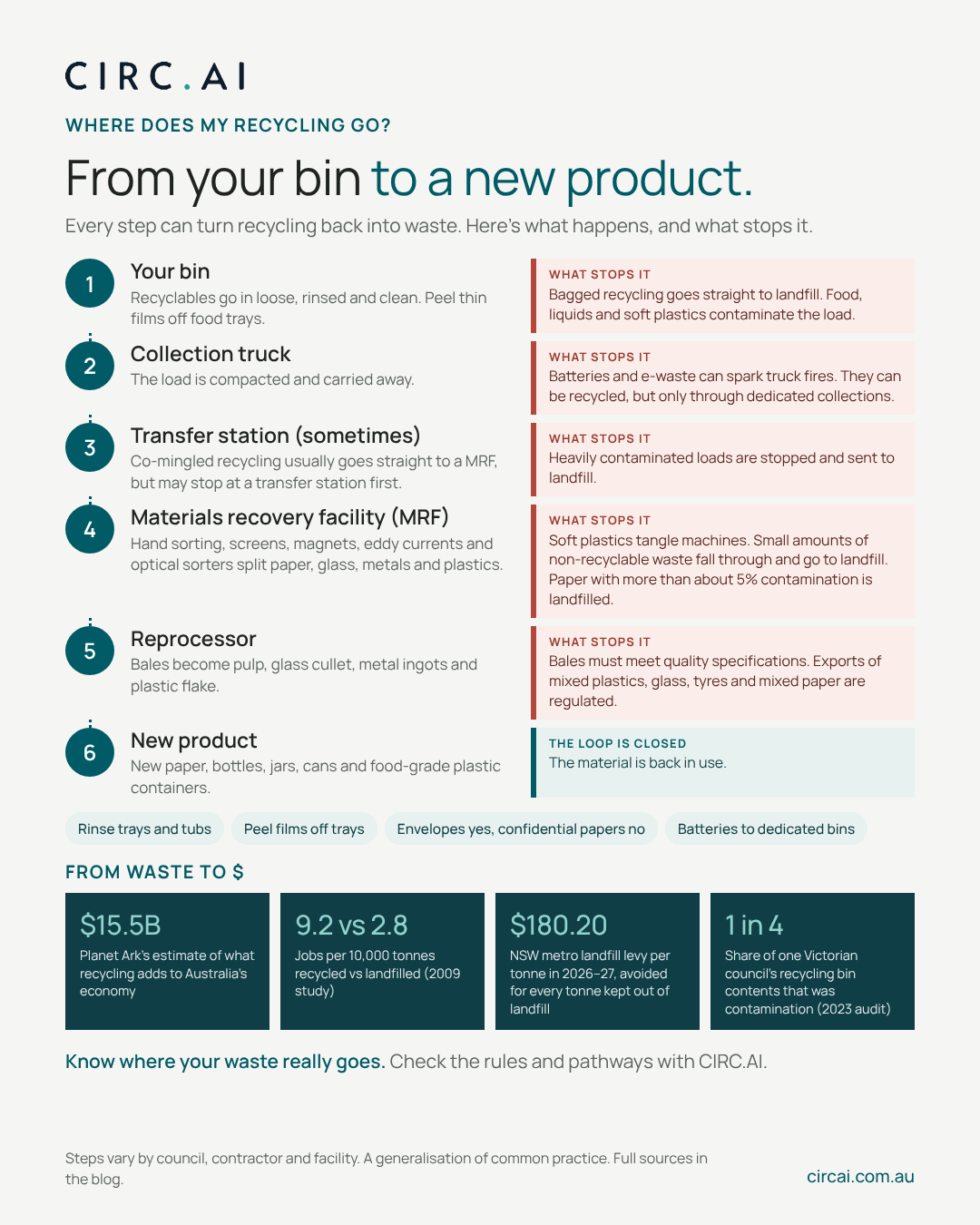
Recycling is a chain. Every link has to work for a bottle to become a new bottle. Here is how the chain works in Australia, and where it breaks.
Step 1: Your bin
Recycling starts with what goes in the bin. Researched examples of what council and state programs accept include paper, cardboard, glass bottles and jars, steel and aluminium cans, and rigid plastic bottles and containers. [1, 2] Accepted items vary, so check your council’s guide.
What stops it: the wrong items. Bagged recycling is sent straight to landfill, because of contamination and safety risks. [3] Soft plastics, food, liquids, ceramics and nappies all contaminate the load. [4]
Contamination is common. Researched examples include:
- A 2023 audit for Yarra Ranges Council in Victoria found 26.77% of recycling bin contents by weight was contamination. [7]
- The City of Port Phillip reports that nearly a quarter of the mixed recycling it collected in a recent year was contaminated. [2]
Step 2: The collection truck
Trucks collect your bin and compact the load.
What stops it: batteries, e-waste and broken glass. Batteries in bins cause fires in trucks and facilities. The Australian Council of Recycling estimates over 10,000 battery-related fires a year across Australia’s waste and recycling systems. [8] Batteries and e-waste can be recycled, but only through dedicated battery and e-waste collections, never the yellow bin. Glass also breaks during collection, and small pieces are harder to recover. [4]
Step 3: The transfer station (sometimes)
Co-mingled recycling usually goes straight from the truck to a MRF. Some loads stop at a transfer station first, where they are combined for the trip. Randwick’s recycling, for example, goes to Visy Alexandria and then to Visy’s Smithfield MRF. The council page does not say what happens at Alexandria. [5]
What stops it: contamination. Heavily contaminated loads are stopped and sent to landfill rather than sorted. Lightly contaminated loads continue to the MRF.
Step 4: The materials recovery facility (MRF)
This is where recycling is sorted. A typical MRF combines people and machines: [1, 6]
- Hand sorting. Workers remove bags, nappies, food and hazardous items at the start.
- Screens. Discs and screens separate flat paper and cardboard from containers.
- Magnets. Magnets pull out steel cans.
- Eddy currents. An eddy current pushes aluminium cans off the line.
- Optical sorters. Sensors identify plastics by type, such as PET and HDPE.
- Glass processing. Glass is crushed, cleaned and screened by size or colour.
- Baling. Each material is baled for sale.
Townsville’s MRF, for example, sorts plastics into six types and processes about 15,000 tonnes of kerbside material a year. [6]
What stops it: contamination and damage. Researched examples include:
- Soft plastics, hoses and strapping tangle around machinery. [3, 4]
- Broken glass embeds in paper and cardboard, lowering its value. [4]
- Batteries and electronics can cause fires or explosions. [2]
- Small amounts of non-recyclable waste fall through the screens and are sent to landfill as residue.
- Dirty paper is hard to recycle. In practice, paper with more than about 5% contamination is usually sent to landfill.
- Oven-proof glass, such as Pyrex, can cause a whole glass load to be rejected. [2]
- Contamination costs money. Port Phillip says its processing fees rise steeply once contamination passes 15%. [2]
Step 5: The reprocessor
Bales are sold to reprocessors, in Australia or overseas. Researched examples from one Victorian council include: [2]
- Paper and cardboard are pulped and made into new paper, cardboard and packaging.
- Glass is separated by colour, melted and remoulded into new bottles and jars.
- Aluminium is baled and melted into ingots overseas.
- Steel is recycled locally or offshore into products such as car parts and appliances.
- PET, HDPE and PP plastics are sent to Melbourne reprocessors and made into food and beverage-grade containers.
What stops it: quality and rules. Sorted materials are graded by quality, and lower-quality material is harder to sell. [16] Exports are also regulated. Under the Recycling and Waste Reduction Act 2020, Australia phased in limits on exporting waste glass (January 2021), mixed plastics (July 2021), whole used tyres (December 2021), single-resin plastics (July 2022) and mixed paper and cardboard (July 2024). [9, 10]
Plastics remain the weak point. In 2020–21, only 13% of plastics were recycled, according to the National Waste Report. [11]
Step 6: The new product
The loop is only closed when the material is back in use: as a new box, bottle, can or container.
Australia generated 75.8 million tonnes of waste in 2020–21, and recovered 63% of it. [11] That figure includes far more than household recycling. A newer national report has since been published, but we could not access its figures for this article.
From waste to $
Recycling is not just an environmental choice. It has economic value. Researched examples include:
- The economy. Planet Ark has estimated recycling contributes $15.5 billion to the Australian economy. [12] The source does not explain how the figure was calculated, and the article is undated.
- Growth. CSIRO’s national circular economy roadmap estimates that lifting Australia’s recovery rate by just 5% would add about $1 billion to GDP. [13]
- Jobs. A 2009 study for the Australian Government estimated 9.2 jobs for every 10,000 tonnes recycled, compared with 2.8 for landfill. [14] The figures are dated, so treat them as indicative.
- Your costs. In levy areas, every tonne kept out of landfill avoids the landfill levy. In NSW, the metro levy is $180.20 a tonne in 2026–27. [15] Contamination costs money too, through higher processing fees. [2]
What you can do
- Keep recycling loose. Never bag it. [3]
- Clean everything. Rinse meat trays, yoghurt tubs and all your recycling. There are two reasons. Food residue starts to smell, and people work around this material at the MRF. Residue also drips onto paper and cardboard, and contaminates it. [4]
- Separate films from trays. Peel the thin plastic film off thicker plastic food trays. Put the film in general waste, or a soft plastics collection where one exists. Put the clean tray in recycling.
- Keep soft plastics out of the yellow bin. They tangle MRF machinery. [3, 4]
- Paper and envelopes are fine, but keep confidential items out. Envelopes can go in recycling. Personal and confidential documents should not, because paper is often sorted by hand. [1, 6] Use a secure document destruction service instead.
- Never put batteries or e-waste in your bins. Both can be recycled through dedicated battery and e-waste collections. [8]
- Check your council’s guide. What is accepted varies.
- For businesses, ask for evidence. Ask your contractor which MRF and reprocessors your recycling goes to, and what happens to rejected material.
Frequently asked questions
Where does my recycling go?
Co-mingled recycling usually goes straight to a materials recovery facility, sometimes stopping at a transfer station first. Sorted materials are baled and sent to reprocessors, which make new products. [1, 2, 5]
What is a MRF?
A materials recovery facility sorts mixed recycling into separate materials, using hand sorting, screens, magnets, eddy currents and optical sorters. [1, 6]
Does my recycling actually get recycled?
Much of it does, but not all. Heavily contaminated loads, MRF residues and dirty paper go to landfill. In 2020–21, Australia recycled only 13% of plastics. [11]
Should I rinse my recycling?
Yes. Food residue smells, people work around this material at the MRF, and it drips onto paper and cardboard and contaminates it. [4]
Can I put confidential documents in recycling?
No. Paper is often sorted by hand, so use a secure document destruction service. Envelopes and everyday paper are fine. [1, 6]
Can batteries and e-waste be recycled?
Yes, but only through dedicated battery and e-waste collections. Never put them in your recycling or general waste bin, as they can start fires. [8]
Why can’t I bag my recycling?
Bagged recycling is sent straight to landfill, because of contamination and safety risks for MRF workers. [3, 4]
Is recycling worth it?
Yes. Planet Ark has estimated recycling contributes $15.5 billion to the economy, and CSIRO estimates a 5% lift in recovery would add about $1 billion to GDP. [12, 13] Businesses also avoid landfill levies.
How CIRC.AI helps
Recycling only works when every step in the chain works. CIRC.AI’s tools help businesses see where their waste goes, and prove it.
CIRC.AI is independent of the facilities and transport providers you need to compare.
- Regulatory Navigator shows the legal requirements for a waste in plain English, across every state and territory and Commonwealth law. Its library covers over 290 laws, regulations, codes and official guidance documents. Each requirement links to the clause behind it.
- Facility Finder will help you find licensed waste facilities and explore potential recovery pathways. It is free for waste generators to use.
- Track & Trace keeps waste movements, supporting documents and final-fate evidence together, with gaps visible.
- CIRC Advisory provides hands-on waste management consulting and assurance.
Check the rules and recovery pathways for your waste. Use Regulatory Navigator.
Related reading
- Out of sight is not out of liability: why you must know where your waste ends up
- Lithium-ion batteries: the fire risk hiding in your waste stream
- What a good waste management plan includes
References
[1] Brisbane City Council – What happens to your recycling (fact sheet). brisbane.qld.gov.au
[2] City of Port Phillip – What happens to my recycling? (June 2026). portphillip.vic.gov.au
[3] Which Bin (Green Industries SA) – Always keep your recyclables loose. recycleright.sa.gov.au
[4] Which Bin (Green Industries SA) – 10 common yellow bin contaminants. recycleright.sa.gov.au
[5] Randwick City Council – Where your waste goes. randwick.nsw.gov.au
[6] Townsville City Council – Materials recovery facility fact sheet (2018). townsville.qld.gov.au
[7] EnviroCom Australia for Yarra Ranges Council – Kerbside waste audit (2023). yarraranges.vic.gov.au
[8] NHVR and ACOR – Homes and businesses hold the power to help prevent waste truck fires (February 2025). wws.nhvr.gov.au
[9] Senate Environment and Communications References Committee – Chapter 7: Waste export regulations and the Recycling Modernisation Fund. aph.gov.au
[10] National EPA – Waste exports and the law. nationalepa.gov.au
[11] Planet Ark – How much waste does Australia generate and where does it go? (February 2023). planetark.com
[12] Canberra Daily – Did you know recycling is worth $15.5 billion? (Planet Ark estimate, undated). canberradaily.com.au
[13] CSIRO – National Circular Economy Roadmap (January 2021). research.csiro.au
[14] Access Economics – Employment in waste management and recycling (2009). agriculture.gov.au
[15] City of Newcastle – Summerhill Waste Management Centre fees (NSW waste levy 2026/27). newcastle.nsw.gov.au
[16] Knox City Council – Where your rubbish and recycling goes. knox.vic.gov.au
This article is general information only and is not legal advice. Requirements vary by jurisdiction, site and waste type. Always confirm your specific obligations with the relevant regulator or a qualified adviser.