
Lithium-ion batteries: the fire risk hiding in your waste stream

By Kim Horwood, Director, CIRC.AI. Environmental scientist with 20+ years in waste regulation.
· 6 min read · Current as at November 2026
The short answer: Never put lithium-ion batteries in general waste or recycling bins. Crushed in a truck or facility, they can short-circuit and catch fire. Tape the terminals, store them cool and dry, and take them to a licensed battery recycler or approved drop-off point. Classification and transport rules differ by state.
Key takeaways
- Industry estimates put battery-related fires in Australia’s waste and recycling systems at over 10,000 a year.
- Lithium-ion batteries must never go in general waste or recycling bins.
- Lithium-ion batteries are Class 9 dangerous goods for transport.
- The same battery can be classified differently in each state, and the rules are tightening.
- Treat used batteries as a waste stream of their own, from collection to recycling.
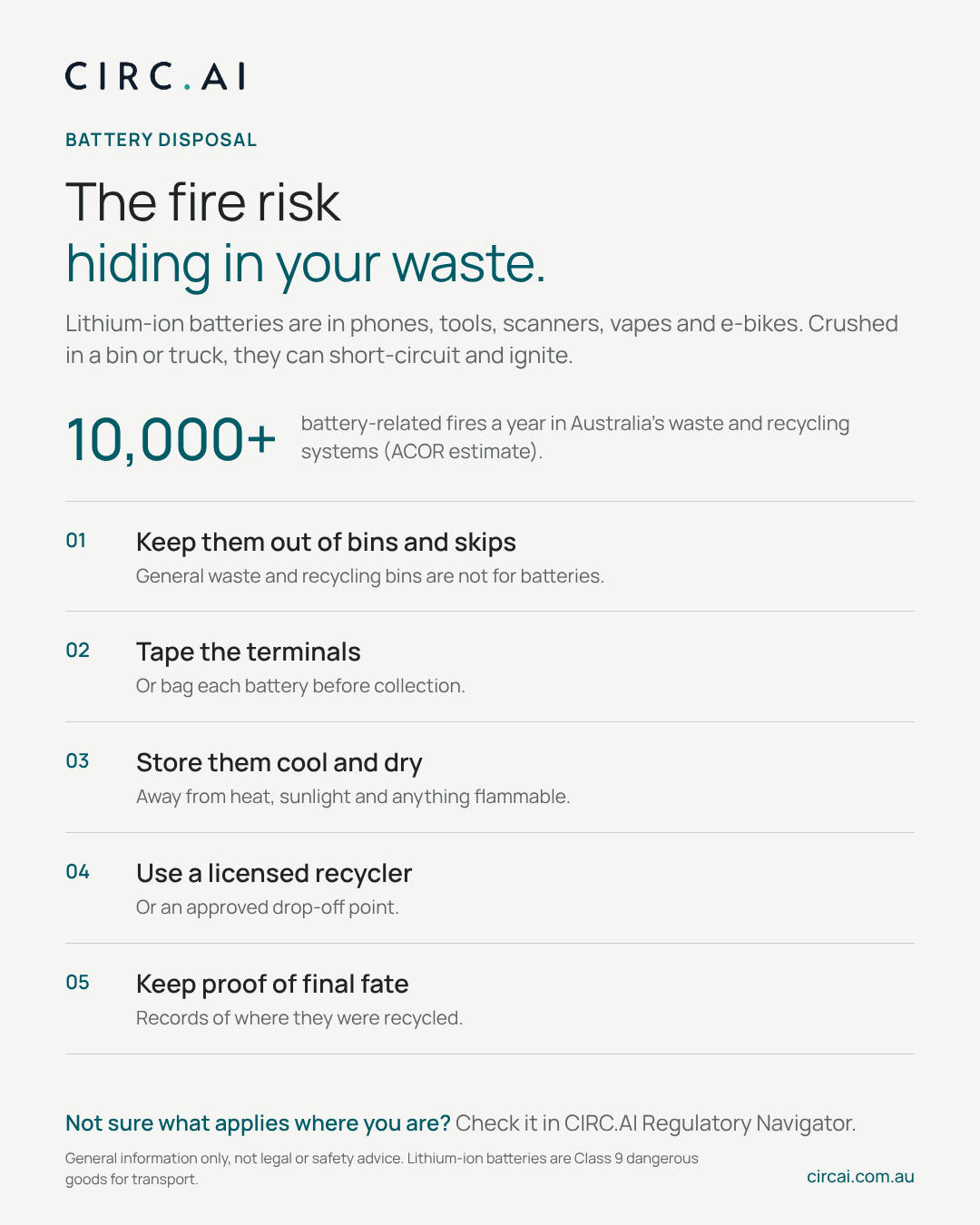
Lithium-ion batteries are everywhere: phones, laptops, power tools, scanners, vapes, e-bikes and backup power units. When they reach the end of their life, many end up in the wrong bin. That is when they become dangerous.
Why are lithium-ion batteries a fire risk in waste?
A damaged or crushed lithium-ion battery can short-circuit, overheat, catch fire or explode. Waste trucks and facilities compact, tip and shred waste, so the risk is high.
The Australian Council of Recycling estimates over 10,000 battery-related fires a year across Australia’s waste and recycling systems. [1] Fire and Rescue NSW recorded 332 lithium-ion battery incidents in 2025. [2]
A Queensland audit of 1,251 household waste and recycling truckloads found batteries or battery-powered products in 95% of them. More than two-thirds of general waste trucks held loose batteries. [3] And an ACCC survey found 39% of Australians didn’t know how to dispose of lithium batteries correctly. [1]
Can you put batteries in the bin?
No. Lithium-ion batteries cannot go in garbage or recycling bins. [4] In Victoria, landfills cannot accept e-waste, and that includes batteries. [5]
Are lithium-ion batteries hazardous waste in every state?
No. The same battery can be classified differently across a border. Researched examples include:
- Victoria. Most battery waste from business and industry is pre-classified as priority waste, and landfills cannot accept it. [5]
- NSW. The pre-classified hazardous list names business lead-acid and nickel-cadmium batteries. Lithium-ion batteries aren’t named, so they must be classified. [6]
- South Australia. Lead-acid batteries are banned from landfill across the state, and so are computer monitors and televisions. [7]
- Queensland. Batteries have no entry on the trackable waste list. [11]
- Western Australia. The e-waste landfill ban covers batteries, other than embedded ones. It binds e-waste service providers, larger businesses and public entities, and landfill operators. [14]
- ACT. Government guidance says batteries must never go in household waste or recycling bins. We found no specific legal ban. [15]
- Tasmania and the NT. We found no battery-specific entry in their controlled or listed waste information. [16, 17] Check with EPA Tasmania or the NT EPA.
Check the classification where the batteries are generated and where they are going.
Are lithium batteries dangerous goods?
Yes. Lithium-ion batteries are Class 9 dangerous goods, and their transport must follow the Australian Dangerous Goods Code. [4] Use a transporter that can carry them lawfully. Waste battery loads may also need hazardous waste permits or tracking in some states.
How do you dispose of lithium-ion batteries safely?
Researched examples of good practice include: [3, 4]
- Find them. List where batteries come from on your site, including tools, devices, vapes, e-bikes and backup power units.
- Keep them separate. Use dedicated battery collection containers. Never put batteries in general waste, recycling or skips.
- Protect the terminals. Tape the terminals or bag batteries individually before collection.
- Store them safely. Keep them cool and dry, away from direct sunlight, heat and flammable materials.
- Deal with damaged batteries fast. Stop using any battery that is damaged or swollen, and keep it apart until it is collected.
- Charge with care. Use the right charger, and don’t leave batteries charging unattended.
- Send them to the right place. Use a licensed battery recycler or an approved drop-off point.
- Get proof of final fate. Keep records showing where the batteries were recycled.
- Train your people. Make sure everyone knows the risks and what to do if a battery overheats.
How do you dispose of car batteries?
Most conventional car batteries are lead-acid, not lithium-ion, but they are still hazardous. In NSW, business lead-acid batteries are pre-classified as hazardous waste [6], and South Australia bans them from landfill. [7] Take them to a battery recycler, scrap metal dealer or approved drop-off point.
What are the new battery rules?
Battery rules are changing. NSW has passed the Product Lifecycle Responsibility Act 2025, which allows a mandatory battery stewardship scheme. [9] Its 2026 regulation makes battery brand owners fund collection and safe disposal. It covers small and removable batteries under 5 kg, such as AA batteries, power banks and e-bike batteries. [2, 8]
The regulation starts on 1 October 2026 if the Act has started by then. Otherwise, it starts when the Act does. [8]
At the time of writing, sources disagree on whether that has happened. A law firm reported the scheme in effect from 1 October 2026 [12], while another source said the Act had not yet commenced. [13] Check the NSW EPA for the current status.
Nationally, B-cycle runs a battery recycling scheme authorised by the ACCC. [10]
Frequently asked questions
How do you dispose of lithium-ion batteries?
Tape the terminals, keep them separate and take them to an approved battery drop-off point or recycler. Never put them in a bin.
Why do lithium batteries catch fire in garbage trucks?
Trucks compact waste, which can crush and short-circuit a battery. It can then overheat and ignite.
Are lithium-ion batteries hazardous waste?
It depends on the state. In Victoria, for example, most business battery waste is pre-classified as priority waste. In NSW, lithium-ion batteries must be classified case by case.
Who pays for battery recycling?
This is changing. NSW has passed a law that allows a mandatory stewardship scheme. Its 2026 regulation makes battery brand owners fund collection and safe disposal, but sources disagree on whether it has started.
How CIRC.AI helps
Battery rules sit across environmental law, dangerous goods law and new stewardship laws, and they differ between states and territories.
CIRC.AI is independent of the facilities and transport providers you need to compare.
- Regulatory Navigator shows the legal requirements for a waste in plain English, across every state and territory and Commonwealth law. Its library covers over 290 laws, regulations, codes and official guidance documents. Each requirement links to the clause behind it.
- Facility Finder will help you find licensed waste facilities and explore potential recovery pathways. It is free for waste generators to use.
- Track & Trace keeps waste movements, supporting documents and final-fate evidence together, with gaps visible.
- CIRC Advisory provides hands-on waste management consulting and assurance.
Check the rules before your batteries leave site. Use Regulatory Navigator.
Related reading
- One Waste, Nine Rulebooks: what hazardous waste is called in each state
- Your waste. Your liability: what every waste generator must do
- What a good waste management plan includes
References
[1] NHVR and ACOR – Homes and businesses hold the power to help prevent waste truck fires (February 2025). wws.nhvr.gov.au
[2] NSW Government – NSW leads the country in battery reform to fight fires and pollution. nsw.gov.au
[3] Queensland Government – Managing end-of-life lithium batteries: shared lessons learned (November 2025). qld.gov.au
[4] SafeWork NSW – Lithium-ion batteries. safework.nsw.gov.au
[5] EPA Victoria – About e-waste. epa.vic.gov.au
[6] NSW EPA – Waste Classification Guidelines Part 1. epa.nsw.gov.au
[7] SA Legislation – Environment Protection (Waste to Resources) Policy 2010, Schedule 4. legislation.sa.gov.au
[8] NSW Legislation – Product Lifecycle Responsibility Regulation 2026 (as made). legislation.nsw.gov.au
[9] NSW Legislation – Product Lifecycle Responsibility Act 2025. legislation.nsw.gov.au
[10] B-cycle – Battery Stewardship Council. bcycle.com.au
[11] Business Queensland – List of trackable waste. business.qld.gov.au
[12] Hamilton Locke – New South Wales battery stewardship scheme now in effect (15 October 2026). hamiltonlocke.com.au
[13] lithium.com.au – NSW’s new battery rules: what’s changing, and when (checked 5 October 2026). lithium.com.au
[14] WA Government – E-waste to landfill ban in WA. wa.gov.au
[15] ACT City Services – Batteries. cityservices.act.gov.au
[16] EPA Tasmania – Controlled waste category codes. epa.tas.gov.au
[17] NT EPA – Waste. ntepa.nt.gov.au
This article is general information only and is not legal advice. Requirements vary by jurisdiction, site and waste type. Always confirm your specific obligations with the relevant regulator or a qualified adviser.