
From Treaty to Tip Face: How Australian Waste Law Fits Together

By Kim Horwood, Director, CIRC.AI. Environmental scientist with 20+ years in waste regulation.
· 14 min read · Current as at October 2026
Ever tried to work out which rules apply to a waste stream in Australia? Some start with an international treaty Australia has ratified. Those treaties shape Australian waste laws and regulations, but the requirements a business needs to follow usually sit in Commonwealth, state or territory laws, permits and approvals.
The details depend on the waste, where it is generated, how it moves and what happens to it. The main rules to check include waste classification, site plans and reporting, offshore waste and exports.
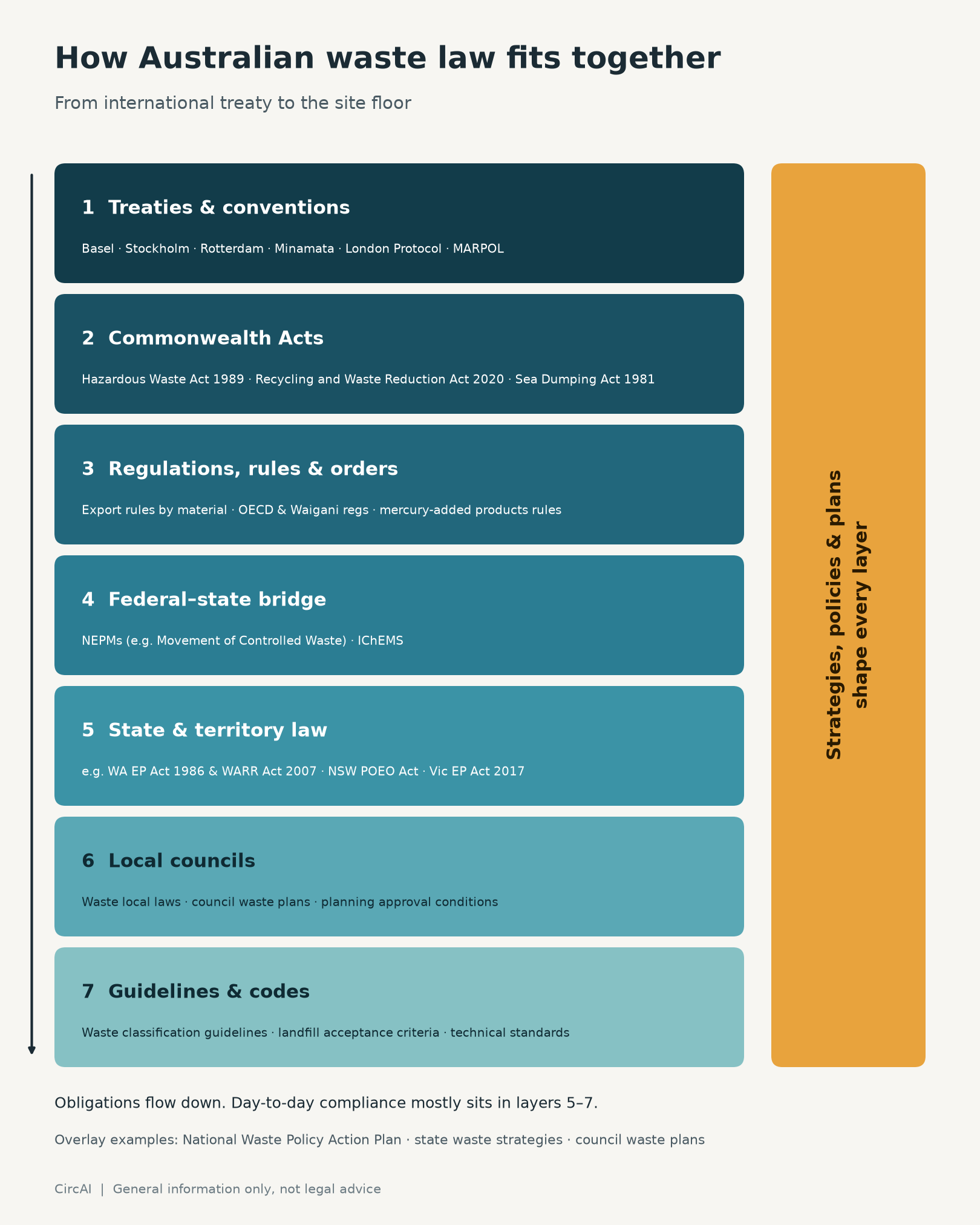
How waste regulation works in Australia
Waste is mainly regulated by the states and territories. The Commonwealth has a role where it has a specific power, including putting some international treaty obligations into Australian law. The Parliamentary Education Office describes waste disposal as a state and territory responsibility.
The National Waste Policy 2018 puts it plainly: waste regulation is directed by the Constitution, international agreements, Commonwealth laws, agreements between governments, and the laws and policies of states, territories and councils. It also says regulating waste is primarily a state and territory responsibility.
That’s why most day-to-day waste requirements come from state and territory laws, with councils setting local rules and providing many waste services.
Layer 1: International treaties and conventions
Australia has ratified several international treaties that affect how waste is managed here. The treaties set obligations for governments. Australia gives effect to them through Australian laws and regulations, which can include Commonwealth, state and territory laws. The treaties do not usually tell a business directly what to do.
The key waste-related treaties include:
- The Basel Convention (hazardous waste moving between countries). DCCEEW notes Australia ratified it in 1992. It requires parties to minimise hazardous waste, control international movements and ensure the waste is managed in an environmentally sound way.
- The Stockholm Convention (persistent organic pollutants) and the Rotterdam Convention (prior informed consent for hazardous chemicals). Australia ratified both in 2004, according to the Global Framework on Chemicals National Plan of Action.
- The Minamata Convention (mercury), which Australia ratified in 2021 according to the same national plan.
- The London Convention and London Protocol (dumping of waste at sea). Australia is a party to both, according to the National EPA.
- MARPOL (pollution from ships). The Australian Maritime Safety Authority explains it is given effect through both Commonwealth and state legislation.
Layer 2: Commonwealth laws
Commonwealth Acts give effect to treaty obligations in areas where the Commonwealth has power. Some requirements are also implemented through state and territory law.
- The Hazardous Waste (Regulation of Exports and Imports) Act 1989 puts the Basel Convention into Australian law. DCCEEW explains that a permit is needed before hazardous waste is exported or imported. The same page notes the Act does not cover movements of hazardous waste within Australia; those are left to the states and territories.
- The Environment Protection (Sea Dumping) Act 1981 fulfils Australia’s obligations under the London Protocol, according to the National EPA.
- The Protection of the Sea (Prevention of Pollution from Ships) Act 1983 is the main Commonwealth law giving effect to MARPOL, alongside the Navigation Act 2012, according to AMSA.
- The Recycling and Waste Reduction Act 2020 is one example of policy turning into regulation. It introduced export controls for certain waste glass, plastic, tyres and paper and cardboard. Material can still be exported if it meets the relevant rules, with the required licence or exemption and consignment declaration. The National Waste Policy Action Plan set the original target to ban these exports; the law put a licensing and declaration system in place. See the government’s waste export guidance. The Act also replaced the Product Stewardship Act 2011.
There is also a newer piece of the picture. Australia’s first independent national environmental regulator, the National EPA, was established on 1 July 2026. According to the Environment Minister’s announcement, the laws it enforces include those on sea dumping, hazardous waste, and recycling and waste reduction.
Layer 3: Regulations, rules and orders
Acts set the framework. The detail usually sits in subordinate legislation made under them: regulations, rules, orders and determinations.
- Under the Hazardous Waste Act, there are separate regulations for waste moving within the OECD area and between Australia and South Pacific countries under the Waigani Convention, according to DCCEEW.
- Material-specific rules set the standards for regulated exports. Paper and cardboard became regulated in July 2024, and from 1 July 2026 each consignment must meet a 5% contamination limit. Exporters must hold the relevant licence and declare each consignment. The government’s export guidance has the current requirements.
- Treaty obligations can also flow through rules. The Recycling and Waste Reduction (Mandatory Product Stewardship—Mercury-added Products) Rules 2021 ban listed mercury-added products in line with the Minamata Convention, according to the national plan.
Rules and orders can change more quickly than Acts, so keep an eye on them for updates.
Layer 4: National measures across jurisdictions
Some waste rules need a consistent approach across Australia. National Environment Protection Measures (NEPMs) set a shared framework, which states and territories apply in their own jurisdictions.
A key example is the National Environment Protection (Movement of Controlled Waste between States and Territories) Measure. It sets the framework for interstate movements of controlled waste. Each state and territory applies and regulates it in its own area.
Industrial chemicals follow a similar model. The Commonwealth maintains the IChEMS Register and sets environmental management standards. Commonwealth, state and territory laws give those standards practical effect, and implementation is progressing at different rates. See the government’s IChEMS guidance.
Layer 5: State and territory waste laws and regulations
This is where most day-to-day waste obligations come from. A Senate Environment and Communications Committee report notes that states and territories regulate waste through licence conditions for facilities and transport, landfill levies and enforcement.
The details change from state to state. Here are three examples:
Western Australia - The Environmental Protection Act 1986 and the Waste Avoidance and Resource Recovery Act 2007 sit side by side. The WARR Act provides for the Waste Authority, local government waste services and waste levies, according to federal waste definitions material. - Under the Environmental Protection (Controlled Waste) Regulations 2004, carriers, drivers and vehicles transporting controlled waste on WA roads are licensed, and movements are tracked electronically, according to the WA Government.
New South Wales - The Protection of the Environment Operations Act 1997 and the Waste Regulation 2014 are the key instruments, according to NSW EPA guidance. - NSW also uses resource recovery orders and exemptions. These let certain wastes be reused without the usual waste controls, provided all their conditions are met, according to the NSW EPA.
Victoria - The Environment Protection Act 2017 is built around a general environmental duty, which requires anyone whose activity risks harm from pollution or waste to minimise that risk so far as reasonably practicable, according to EPA Victoria. - The Act sets 13 duties in total, including seven waste duties, according to the same EPA Victoria page.
Layer 6: Councils and site-level requirements
Local councils aren’t mentioned in the Constitution. Their powers come from state law, and the Parliamentary Education Office notes their by-laws can be overruled by state laws.
Even so, councils matter a great deal for waste. The National Waste Policy describes their role in household collection and recycling, running landfills, education, litter, and enforcement against littering and illegal dumping. Councils also put waste conditions on development approvals through the planning system.
In WA, the WARR Act lets councils make waste local laws covering things like waste services and bins, with the consent of (or when directed by) the head of the state environment department, according to the WARR Act. The WA Government explains that councils in Perth and Peel and the major regional centres must prepare waste plans that align with the State waste strategy.
Some businesses need a written waste plan for a particular project or site if a planning approval, environmental licence or other permission requires one. Licences and state laws can also set record-keeping and reporting duties. These vary with the activity, waste type, jurisdiction and any thresholds or licence conditions. For example, the NSW EPA requires reports for certain waste movements and for non-compliance with environment protection licence conditions. In Victoria, Waste Tracker records transactions involving reportable priority waste. Companies may also set their own waste procedures, but an internal plan does not replace any legal duties. There is no single national plan or reporting form for every business.
Layer 7: Guidelines and codes used on site
Legislation sets requirements, but it doesn’t always explain how to classify a waste or manage it on site. That’s where guidelines, codes of practice and technical standards can help.
- In WA, the Landfill Waste Classification and Waste Definitions 1996 (as amended 2019) set the criteria for deciding which class of landfill can accept which waste, according to the WA Government.
- In NSW, waste is classified using the EPA’s Waste Classification Guidelines, which use a five-step process, according to Transport for NSW.
- In Victoria, industrial waste must be classified and given a waste code to work out which duties apply, according to EPA Victoria.
- The PFAS National Environmental Management Plan (PFAS NEMP) gives nationally consistent guidance for managing PFAS contamination. States and territories apply it through their own regulatory systems.
- For asbestos, Safe Work Australia’s model Codes of Practice cover managing and controlling asbestos in the workplace and how to safely remove asbestos. Check with your state or territory regulator: a model code has legal effect only if it has been approved in that jurisdiction.
These documents don’t all work the same way. A licence or approval may also make a particular guideline or code a condition. Check the wording of your site’s approvals and the rules in your state or territory.
Special case 1: Waste generated offshore and brought ashore
Waste from a platform, vessel or remote island can pass through several hands before it reaches a treatment or disposal facility. The rules can change as it moves from offshore to onshore, so it helps to be clear about who is responsible at each step.
The rules at sea depend on where the activity is. Petroleum activities in Commonwealth waters beyond three nautical miles from the territorial sea baseline are covered by the Offshore Petroleum and Greenhouse Gas Storage Act 2006 and regulated by NOPSEMA. Within three nautical miles, regulation stays with the state or Northern Territory unless powers have been handed to NOPSEMA. Victoria, for example, has its own Offshore Petroleum and Greenhouse Gas Storage Act 2010 for its state waters, according to Resources Victoria.
On the platform, the environment plan sets the rules. An offshore petroleum activity can’t begin until NOPSEMA has accepted an environment plan for it, according to NOPSEMA. Waste is a standard part of these plans. One accepted plan includes the outcome that waste is segregated and disposed of onshore in line with relevant legislation, according to NOPSEMA’s acceptance decision. Another describes hazardous wastes such as waste oil, separator sludge, oily filters and chemical drums being stored on the platform and transported onshore, according to a NOPSEMA plan summary.
MARPOL Annex V generally prohibits ships from discharging garbage, with limited exceptions. For offshore platforms more than 12 nautical miles from land, ground food waste that can pass through a 25 mm screen may be discharged. Other garbage, including plastics, must not be. Ships alongside or within 500 metres of a platform also face restrictions. Ships of 100 gross tonnage or more, or certified to carry 15 or more people, must carry a Garbage Management Plan; some must also keep a Garbage Record Book. Check the rules for the vessel and location. (Sources: AMSA discharge standards and Australian Maritime Safety Authority.)
At the wharf, port and biosecurity requirements can both apply. Australia must provide port reception facilities for ship-generated waste. A vessel that delivers waste to a reception facility should receive a waste delivery receipt and keep it with the relevant ship records. Vessels arriving in Australia on an international voyage must also meet Australian biosecurity requirements. Additional restrictions can apply to food and other waste on board, and waste brought ashore may need an approved arrangement, depending on the material and circumstances. (Source: AMSA, Department of Agriculture, Fisheries and Forestry)
Once it’s onshore, state law takes over. Where offshore waste is treated and disposed of onshore, managing it is primarily a state and territory responsibility. That includes licensing transport, storage, treatment, resource recovery and disposal, according to the offshore petroleum decommissioning guideline. From the quayside, the state’s classification, controlled waste transport and tracking rules apply, as for any other site.
Islands face the same mix, plus distance. Christmas Island’s landfill is licensed under Western Australian law as applied to the island, including WA’s controlled waste regulations, according to its WA environmental licence. Research for the Indian Ocean Territories notes that shipping costs and biosecurity checks at Fremantle make it expensive to send waste to the mainland, and that WA’s ban on e-waste in landfill means e-waste has to be shipped out, according to the National Environmental Science Program. Some movements needed specific changes to the law. For example, new laws in 2019 allowed asbestos to be removed from the Indian Ocean Territories for disposal on the mainland, according to a parliamentary inquiry submission.
Offshore waste may pass through several hands between the platform or island and the final facility. Keep one record that follows it from generation through transport, receipt and treatment.
Australian waste export rules: sending waste overseas for treatment
Some waste is sent overseas because the right treatment isn’t available in Australia, or because a suitable recovery market is elsewhere. Two Commonwealth laws can apply, and some shipments need to meet both.
You need a permit under the Hazardous Waste Act to export, import or transit hazardous waste. Whether the Act applies depends on its definitions and the relevant Basel or Article 11 arrangements; the waste description alone is not enough to decide. The movement also needs consent from the countries involved and any required state or territory facility and transport approvals. A biosecurity permit may also be needed if imported waste presents a biosecurity risk. (Source: DCCEEW, DCCEEW’s permits page)
The National EPA says it typically grants hazardous waste export permits only when there is no capacity to process the waste in Australia. Exports for final disposal, such as landfill or incineration, are granted only in exceptional circumstances. For 1 July 2026 to 30 June 2027, the application fee is $16,780 for recovery operations and $46,409 for other operations.
Plastic is one to check carefully. Amendments to the Basel Convention in 2019 brought more plastic waste under international controls, according to DCCEEW. Waste plastic needs a hazardous waste permit rather than a standard export licence if, for example, it isn’t almost entirely one polymer, isn’t almost free of contamination, is PVC, is processed engineered fuel, or isn’t being exported for recycling, according to DCCEEW’s plastic exports page.
Certain glass, plastic, tyre, paper and cardboard exports need a licence or exemption under the Recycling and Waste Reduction Act 2020. Each consignment must be declared through the National EPA's WELD portal and the Australian Border Force's Integrated Cargo System. A single licence can cover glass, plastic and tyre exports; paper and cardboard require a separate licence. The application process also considers the applicant's financial capacity and environmental history. (Source: business.gov.au fact sheet, DCCEEW, DCCEEW’s evidence requirements)
There are detailed record-keeping requirements. Exporters must keep records for at least five years, including the waste type, quantity, destination and intended use, along with time-stamped photos of each layer as the container is packed. From 1 July 2026, each paper and cardboard consignment must contain no more than 5% contamination by total weight. (Source: DCCEEW’s record-keeping guidance)
State and territory requirements still apply before the waste leaves Australia. The Commonwealth regulates the international movement, while storage, transport and treatment before export may need separate local approvals and licences. (Source: DCCEEW)
If you’re planning an export, check the controls before the waste is packed. You may need approvals in Australia and in the destination country, and missing paperwork can hold up a shipment.
Strategies, policies and plans
Strategies and policies show what governments want to change or improve. They usually aren’t laws themselves, but they can lead to new laws, rules or guidance later.
National. The National Waste Policy Action Plan sets seven national targets, including an 80% average resource recovery rate by 2030 and halving organic waste sent to landfill. The same page notes the recovery rate reached 67% in 2024–25, and that environment ministers agreed a new 2024 Action Plan.
The Action Plan included a target to ban exports of waste plastic, paper, glass and tyres. The Recycling and Waste Reduction Act 2020 introduced controls for regulated exports. It is not a blanket ban: qualifying exports can still go ahead under the licensing rules.
State. WA’s current Waste Avoidance and Resource Recovery Strategy 2030 targets 75% material recovery by 2030. It also aims for no more than 15% of Perth and Peel waste to go to landfill. Its proposed replacement, Beyond Waste 2030, was out for consultation in late 2025, and in July 2026 the final version was being considered by Government, according to the Waste Authority.
Local. Council waste plans turn state strategy into local services, contracts and local laws, as the WA Government describes.
Common questions about Australian waste law
What laws regulate waste in Australia?
There is no single law covering every waste stream. Most day-to-day requirements come from state and territory laws, licences and approvals. Commonwealth laws apply to areas such as hazardous waste exports, while the Controlled Waste NEPM provides a framework for interstate movements.
Does every site need a waste management plan?
There is no one national requirement for every site. A plan may be required by a site approval, environmental licence or other permission. Businesses may also set their own procedures, which do not replace legal requirements.
When do businesses need to report waste?
Reporting depends on the jurisdiction, waste type, activity and any applicable licence conditions or thresholds. Requirements can include waste tracking, incident notifications or periodic returns.
Can waste be exported from Australia?
Some waste exports are regulated and need a licence or exemption, along with a declaration for each consignment. Hazardous waste may also need a separate permit. The rules depend on the material and destination; the export controls are not a blanket ban.
What to check for your site
Most day-to-day requirements come from the state or territory where you operate. Check the waste classification, transport and facility rules, along with any licence, approval or council conditions that apply to your site.
If waste crosses a state border, comes ashore from offshore or is sent overseas, check the extra rules before it moves. Keep a simple register of the waste streams at each site, the requirements that apply, who is responsible and when you last checked them.
Rules and guidance can change. When a treaty, national target or state strategy changes, check whether that has led to a change in legislation, licence conditions or site procedures.
How CIRC.AI helps
Keeping up with waste rules across state lines takes time. Regulatory Navigator helps you find requirements that may apply to a site or waste stream. CIRC.AI also has tools for waste classification, movement records and facility searches. See CIRC.AI’s waste tools and advisory services.
This article is general information only and is not legal advice. Requirements vary by jurisdiction, site and waste type. Always confirm your specific obligations with the relevant regulator or a qualified adviser.